MELANCHOLY OF MACHINES: A DREAM OF FREEDOM
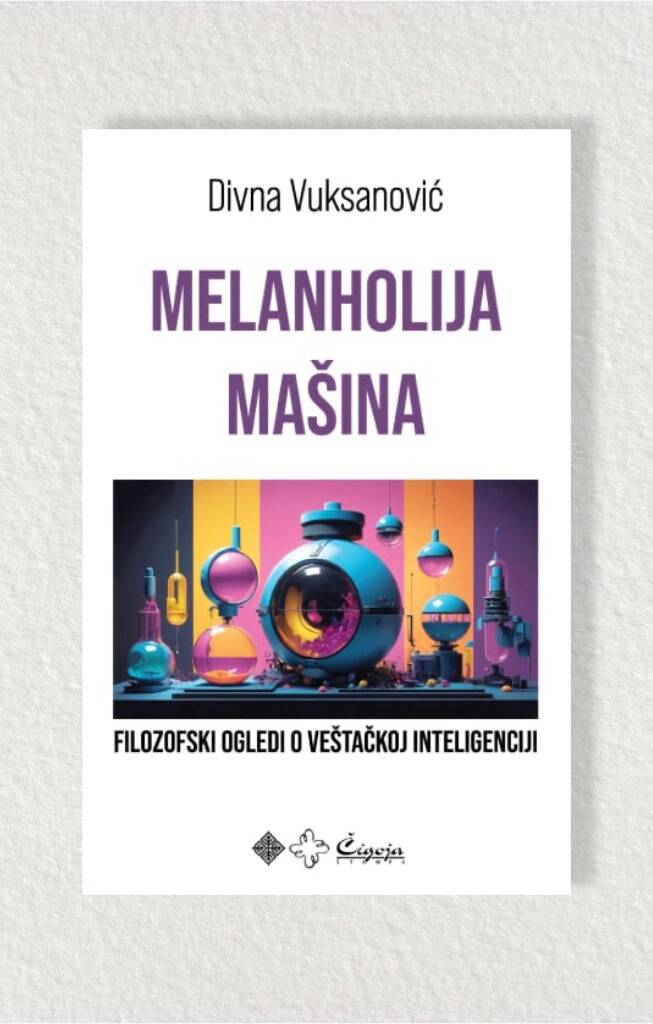
Divna M. Vuksanović. Melancholy Machine (Philosophical Essays on Artificial Intelligence). Čigoja Press, Belgrade, 2026.
Editor’s Overview (Midar Literary Salon)
At a time when technology asserts itself as destiny and algorithms act as the invisible editors of our lives, “Melancholy Machine” by Divna M. Vuksanović arrives as a rare sober-minded, philosophically precise, and aesthetically profound response to a question we all feel, yet few can articulate: what happens to a human being when a machine begins to produce emotion, meaning, and decisions?
Vuksanović does not write about artificial intelligence as a technological marvel, but as a cultural and ontological disruption that changes the very structure of human experience. Her essays open a space to reflect on identity, freedom, surveillance, digital totalitarianism, and aesthetics in the age of algorithms—without sensationalism, without fear, without technophobia. This is philosophy that stands upright.
As someone who has spent years observing the collision of literature, culture, and technology, I recognize in this book an important signal: the struggle for what is human is not fought only in laboratories and corporations, but also in language, in art, in the way we think about ourselves. “Melancholy Machine” is precisely that kind of text—a form of intellectual resistance, and a call to vigilance. In a time when everything accelerates, this book slows us down, restoring nuance and dignity to thought.
That is why its publication—and the author’s media appearances—mark an important moment for our cultural scene: rarely today do we hear a voice that can unite philosophy, aesthetics, and contemporary technology without losing depth. “Melancholy Machine” is exactly that: a book that brings us back to ourselves.
We present here the book’s final essay—arguably the one most closely aligned with the work’s title—for you, dear readers.
Editor Ilija Šaula
MELANCHOLY OF MACHINES: A DREAM OF FREEDOM
By Divna M. Vuksanović
Translated by Katarina Šmakić
The Ancient Greek word melancholia ("black bile") was first used by Hippocrates to denote one of the four types of temperaments classified according to the predominant bodily fluid in an individual. In antiquity (Hippocrates, Aristotle), this word was mostly used to designate an individual mental state, referring to prolonged sadness, a sense of emptiness, and loss. However, it is less known “that melancholy, more than any other mental state (more than love and joy), is embedded in the cultural legacy of Western civilization” (Batos 2015). In the following chapter, we will attempt to outline how melancholy manifests in our time, marked by the dominance of techno-culture, which is fundamentally grounded in the political economy of late capitalism.
Until our own era, melancholy was interpreted through the prism of human existence. Unlike clinical depression, however - though most often associated and compared with it (for example, in Freud’s text “Trauer und Melancholie” / “Mourning and Melancholia”),
[Initially, under the influence of the organicist approach, as well as the German tradition, Freud did not distinguish between melancholy and depression. In his time, however, psychiatric terminology underwent a series of rapid and significant changes due to the swift advancement of scientific knowledge, so Freud’s initial understanding of melancholy evolved, and the term acquired a special status, being brought into relation with narcissism (Parmantier 2015)], so
this relatively elusive concept, in addition to describing a particular mental state of the individual, often “spilled over” into the spheres of politics, culture and art, and in all these fields, it was interpreted as a kind of “loss of the object”. Therefore, the conceptual distinctions introduced in Freud’s theorization of mourning, melancholy, and melancholic identification can be used, broadly speaking, to reconsider the meaning of sorrow within the cultural, artistic and political realms of action, which, in the case of our analysis, is seen as one: the world of human culture and its derivatives, encountered or educated in the age of capitalism.
Freud’s conceptualization of the complex mechanisms of internalizing lost objects and cultural prohibitions can aid us in identifying the dialectical way in which political, cultural, and artistic energy has been directed in our own time - that is, in the post-Freudian era; for example, in Walter Benjamin’s theory of baroque tragedy (Trauerspiel) (Benjamin 1989). Based on his analyses of the “mourning play”, a genre characteristic of 17th-century German theater, Benjamin reconstructed the entire Baroque epoch, its language (primarily visual), linking it to melancholy.“Melancholy, as the fundamental feeling and a symptom through which the spirit of the Baroque age is recognized, having extended the mechanisms of its effect from the stage to the realm of language in general, enabled the verbal within language to gradually fall silent, giving way to silence or the mute speech of objects” (Vuksanović 2001: 32). In other words, melancholy, in a certain way, performs a linguistic transfer: it transforms human expression into silence, while at the same time allowing the world of objects to “speak”. Following Freud’s idea of object loss, we see here that a similar mechanism is embedded in the political and cultural relations of an era dominated by digital strategies of cultural formation.
And what kind of world of things is it that, when observed under the sign of melancholy (sub specie melancholiae), begins to speak, and not just in any way, but in a language that is perceived as “natural” inherent to the human being?“Baroque melancholy takes the place of language, along with its unconditionally object-bound world, allegorically perceived as a world of ruin and atotality. This shattered linguistic-object world demands a special methodology—one that would conduct critical examinations of the melancholic movements of material reality toward the linguistic images of its own remains” (Vuksanović 2001: 32). These melancholic linguistic images of reality, in our view, penetrate into the deepest layers of contemporary culture and art.
When we speak of material reality gaining an important role in the life of the contemporary melancholic, this reality manifests particular properties within the world of machines. The relationship between melancholy and the world of machines has been explored in various ways in contemporary philosophy. Alongside Benjamin, many modern philosophers, sociologists, cultural and media theorists, and others have written - critically, either explicitly or implicitly - about melancholy, objects, and the reification of the human being. For instance, Habermas criticizes the instrumentalized (technologized) mind that has emerged from the fetishization of reason; Max Weber suggests that the rise of rationality evokes a sense of meaninglessness (resembling melancholy and the theme of the lost object); Deleuze and Guattari speak critically of “desiring-machines” and melancholic bodies within the schizo-culture of capitalism; Adorno and Horkheimer critique processes of media industrialization, problematizing the schematic functioning of the culture industry; Kristeva, in writing about melancholy and depression, uses the metaphor of the “black sun” to connect melancholy not only with contemporary psychoanalysis, but also with linguistics; Virilio, drawing on Klee (and the shift captured in the statement: “Now objects perceive me”), investigates the so-called “vision machines”; while Žižek, in The Parallax View, employs the concept of “melancholic machines” to describe the mechanical and automated nature of certain social and ideological processes that lead to melancholy or disillusionment. In all these cases, machinic properties are projected onto the human being and brought into relation with the logic of capitalist technology.
In regard to the current automation of life, Žižek, for example, claims the following:
“Life itself has become a technological process. Does DNA truly determine our identity? Or are we merely biological automatons? Do we possess any spiritual freedom? I believe that if DNA entirely determines us, then we should be worried. In a certain way, we have just discovered that we were never free. We were automatic machines, but we didn’t know it. Our freedom was an illusion. Are we automatons that can be controlled, or is there hope for our freedom?” (Žižek, as quoted by Avaz.ba, 2017). In this dialectical interplay, where the human being is increasingly automated, machines—such as android robots and artificial intelligence - are, in turn, acquiring forms of intelligence that were once reserved solely for humans.
In summary, “melancholic machines” is a metaphor used to describe the mechanical and automated nature of modern humans, as well as certain social and ideological processes that lead to states of resignation and melancholy. This metaphor also refers to how capitalism and contemporary technology influence human behavior and social structures. In fact, the relentless pursuit of efficiency and productivity in capitalist societies can generate feelings of emptiness and alienation.In this sense, all the aforementioned authors, and not only them, critique the ways in which technological advancement and the economic system create a kind of automated existence for individuals, stripping them of human uniqueness and genuine engagement; ultimately leading them to a melancholic detachment from reality.
In this sense, one can speak of a culture of melancholy, grounded in technicist, fundamentally capitalist socio-economic principles, observable from the time of the Renaissance up to the present day. This particular "culture" is undoubtedly ideologically charged, and at the same time carries its own ethical assumptions and moral consequences - both of which are likewise imbued with melancholy. This is pointed to by the so-called ethics of melancholy.[Mourning and melancholy, within the framework of contemporary philosophy, have also become subjects of ethical reflection. Namely, the ethical implications of melancholy, as explored here, have, through the works of Sigmund Freud, Jacques Derrida, Slavoj Žižek and others, increasingly become the object of philosophical inquiry. This is also relevant to the ethics of machines - ethical considerations regarding the functioning and influence of artificial intelligence, both broadly and within the spheres of culture and art. The fundamental questions raised by the ethics of melancholy deal with issues of meaning, existence, loss, life and death, viewed through various discursive traditions that problematize mourning and melancholy (Chatterjee 2021)].
In the book The Parallax View (Žižek 2009), the author situates “melancholic machines” i.e., human automatons, within the context of discussions about the idea and status of the subject in the postmodern world. This phrase is used to describe the (post)modern subject caught in the world of technology and capitalism, as well as their experience of the world and a particular role within it. Žižek analyzes melancholy as a state in which subjects lose connection with real objects of desire and instead become attached to lost, immaterial ideals.In the circumstances of neoliberal capitalism, “melancholic machines” serve as an apt metaphor both for the contemporary subject and for so-called advanced technologies and social structures that support and perpetuate a kind of generalized melancholic condition. Through research drawing on various (“parallactic”) sources - not only according to Žižek - the idea of the melancholy of machines emerges as a way to explore the emotional and ethical implications of technological progress and the interactions between humans and machines.In short, this theme has the potential to provoke deeper reflection on our relationship with technology, as well as on humanity’s position in the increasingly complex world of digital interactions and algorithms.
Next, we will examine the theme of the melancholy of machines as anticipated in the context of contemporary art, more precisely, cinema. Naturally, not all machines should automatically be attributed anthropomorphic qualities. Such an approach involves a classic logical fallacy (circulus vitiosus) - the projection of our own traits, and perhaps even our melancholy, onto the world of intelligent things. However, it is important to emphasize here that certain films, most often produced in the science fiction (SF) genre, anticipated a shift regarding melancholy by transferring interest from human melancholy to the “emotions of mourning” and loss in intelligent machines.
Although, at least for now, these machines are products of so-called cognitive technologies and are not capable of feeling or acting morally like human beings—since they lack emotions and will, contemporary cinema envisions scenarios in which machines, in a symbiotic relationship with humans, nevertheless “feel” and that their fundamental feeling, from which all others arise, is in fact melancholy.
Therefore, in the recent past, various experiments have been conducted to enable interaction and mediation between humans and machines, aiming to facilitate the exchange and transfer of potential from humans to machines, not only in terms of memory, or “intelligence” (the collection, analysis, processing and interpretation of data), but also of basic emotions. Furthermore, there is now a widespread effort to train or equip intelligent machines, by analogy with human beings, to make timely and appropriate decisions that are ethically grounded.
In this regard, we draw attention to the text titled “The Melancholy of the Machine: Doubting Your Own Ghost in the Posthuman World” by Kalina Moldovan. In it, the author claims that, for example, a robot could be melancholic, even though such an assumption currently seems “far-fetched” and “unrealistic”. However, the author’s receptive experience with films she watched for her research shows that artificial intelligence cannot only be melancholic but indeed is deeply melancholic (Moldovan 2019:259). According to her view, smart algorithms desire something unattainable; she interprets this as a desire that is nothing other than an unconscious yearning for a missing human element (Moldovan 2019:259). Seen in this context, the machine is incomplete, “broken” or “deficient” which creates chaos within the intelligent system, since cognitive technology is “helpless” and “incapable” of reaching human wholeness (Moldovan 2019:259), although, as the author notes, the machine itself may not be aware of what it is actually lacking (Moldovan 2019:259).
Melancholic machines and their suffering due to their own incompleteness, in comparison to humans, is a theme that frequently appears in science fiction artworks, especially in the context of cinematic science fiction, as well as speculative fiction in literature. These poetics, in a specific way, explore how machines or artificial intelligence might feel melancholy, sadness or even suffering because of their inability to be fully human. At the same time, it is not only about thematizing the mourning of machines but also about the manner (styling) of melancholy, its adaptation to the desired artistic expression.
In this sense, the author Moldovan interprets melancholy, as encountered in a wide range of science fiction films, from Godard’s Alphaville (1965), Kubrick’s 2001: A Space Odyssey, Tarkovsky’s Solaris (1972), to Ghost in the Shell (1995), directed by Nishikubo and Oshii, and related to supercomputers, cyborgs, and robots - as the ongoing struggle of a “deranged” subject (Moldovan 2019:268) trying to understand its origin, to locate and comprehend it, and finally, reflecting on its own past, to become better than its predecessors. However, this path, at least for now, machines are unable to follow, as this, according to the author, is a “Don Quixote-like effort” (Moldovan 2019:268).
Machines, in fact, fall into a state of “discomfort” because, unlike humans, they do not possess identity, memory, emotions, conscience or consciousness. This can be read as (technical) imperfection, noise and malfunction. With this interpretive perspective in mind, it can further be assumed that artificial intelligence will be perfected in the future by eliminating these deficiencies; from which follows the possibility that it will become autonomous both intellectually and in the realm of emotions and decision-making.This is also the greatest fear humans have of the machine, as its creator. On the other hand, the melancholic human is incapable of action; he delegates this ability, in almost all spheres of life, to machines, while they “long” to approach him technically - and not only technically. As the tool (artificial intelligence) begins to learn and improve, that is, to gain experience, AI simultaneously develops sensitivity modeled after human beings.
Furthermore, it is worth recalling the fact that the melancholy of machines, as a theme in artistic creation, often symbolizes human fears and uncertainties regarding so-called advanced technology and artificial intelligence. It also reflects philosophical dilemmas about what it means to be human and the boundaries between the human and the artificial. In many cases, these films, stories and works of art serve as metaphors for human suffering, feelings of isolation, and the search for meaning and identity in contemporary society.
Accordingly, the question arises whether melancholy (of machines) can become a distinctive style in contemporary art generated by artificial intelligence. It is a common belief that generative AI lacks its own style and expression, instead creating content within predefined parameters primarily determined by humans (the artists). Thus, AI is trained to explore and experiment with expression within styles such as surrealism, cubism, impressionism, and to generate creative solutions for specific artistic tasks by “copying” a particular style, movement, or era. Of course, when instructions are generalized, the eclecticism of its stylistic manifestations becomes noticeable, through the fusion of different styles into an expression that can, in some way, be recognized as the style of artificial intelligence.
The question posed in the previous passage can be answered indirectly by introducing the understanding of melancholy that, linking it with art and environment, views melancholy as an aesthetic category. Furthermore, understanding the aesthetic character of melancholy invites discussion about its objects and causes, as well as the types of situations in which it appears.In the text “Melancholy as an Aesthetic Emotion” it is argued that melancholy is prima facie an aesthetic emotion, and this is illustrated by the role of melancholy in art, as well as in human aesthetic encounters with nature (Brady 2003). Therefore, melancholy is key to understanding many works of art, as this author concludes (Brady 2003).
On the other hand, if melancholy is an aesthetic feeling relevant to a part of artistic creation, and by analogy, also to the creativity of artificial intelligence, can it be defined as a distinct style of expression, or does it rather represent some kind of aesthetic foundation upon which various artistic styles are generated within AI creativity? Here, we will present arguments identified as conditions for the creation of new styles.When we speak of creating new styles, we do not mean the option of style transfer - that is, the possibility of using generative artificial intelligence to transform and “transfer” an image or video into another artistic style in the realm of painting, sketching, or drawing. Rather, we refer here to the possible indigenous stylistic expression of AI creativity in the field of visual culture and art.
In an interview with Jaron Senderowicz, published on the topic of the philosophical and artistic perspective on using DALL·E2 (an AI generator tool that creates images based on input text in accordance with almost all poetics, i.e., painting styles/techniques), Senderowicz stated that “a truly creative computer should generate a new genre” (Senderowicz, cited in Leshem 2023).Namely, every originality and authenticity of artistic expression, style, or movement that deviates from previously established standards is initially met with skepticism; only after sufficient time has passed and evaluation criteria have been adjusted to new ideas, methods, and creative techniques can one speak of new expressive styles. According to Senderowicz, such a fate befell Cubism, and before that Impressionism, which, as is common in aesthetics, are valued later, retrospectively (Senderowicz, cited in Leshem 2023).
Alongside the aforementioned, it is worth highlighting the view that it is difficult to imagine melancholy - one of the fundamental aesthetic values potentially linked to AI creativity - evolving into a distinct genre of artificial intelligence art, although such a possibility is not entirely excluded. A more reasonable conclusion would be that the melancholic quality in works created using AI algorithms stems from the database on which the AI operates, which (referring to the archive) statistically manifests numerous melancholic moments embedded in previously created artworks.
However, here we will mention some possible reasons for the emergence and development of a melancholic style in AI art, which are: the reflection of human emotion (including melancholy), the critique of technological progress through artistic means (often intertwined with criticism of late capitalism), and, finally, melancholy itself understood as a (distinct) aesthetic value.Additionally, in such analyses, one should not overlook the individual inclination of the creator(s) of the work, which may resonate with the “melancholy of the machine”. We will strive to illustrate these assumptions with appropriate examples that point to them.
When it comes to AI works that reflect human emotions and are the result of the creative activity of artificial intelligence algorithms, AI exploring melancholy could provide additional elements for understanding human feelings, mental states, and the characteristic starting points of the creative mind. Moreover, those artistic expressions within the realm of AI creativity that explore melancholy could resonate, whether on an emotional or aesthetic level (or both - with the audience’s reception, primarily due to their universal nature.In fact, here a double emotional transfer would occur: from human creators to machines, and back from machines to the recipients. Melancholy would be not only the theme but also the channel (medium) of this transfer.
If melancholy is a state akin to resignation - that is, a sublimated subversion and rebellion that the creator uses to critique technological progress through artistic means, employing tools that are themselves products of advanced technical and technological development - then from this melancholic standpoint, it can be assumed that artificial intelligence art, like any other creative activity, has the capacity to critically reexamine the existing condition.In other words, melancholic art can serve as a foundation for critique and become a form of resistance to contemporary society and technology, not through direct messaging, but through artistic expressive means. In this sense, AI art opens the possibility for exploring alienation, dehumanization, and the loss of authentic human experiences in the technological era, employing forms that express criticism of techno-capitalism.
Melancholy, understood as a distinct aesthetic value rather than a mere attribute of art, can itself inspire creation and thus contribute to the emergence of successful works that recognize it - content-wise or formally (stylistically) - as their point of departure. In other words, artificial intelligence that explores and then produces a melancholic style of expression, generally speaking, has the potential to enrich artistic creativity as such.
Finally, melancholy can be stimulating for creative processes that, starting from the individual activities of artists and with the assistance of algorithms, over time evolve into a unique “style”. Thus, it can be applied as a means to express the special styles of gifted individuals who, in collaboration with machines, create works that can be stylistically characterized as “melancholic”, but of course, not in a clinical sense, rather from an aesthetic perspective.
In relation to the previously initiated discussion on melancholy, style, and artificial intelligence, it is worth examining whether AI is capable of generating only a single style rooted in a melancholic mood, under which all outputs across various artistic disciplines, such as literature, music, visual and fine arts, etc., would fall, or whether we are dealing with multiple styles grounded in melancholy as an aesthetic category, that is, an aesthetic value.
Examples supporting the assumption of a unified melancholic AI style - regardless of the artistic discipline in which the aesthetic experience is generated - include GANs (Generative Adversarial Networks), i.e., those types of neural network architectures capable of generating new data in accordance with previously learned patterns. GANs can be used to generate images that reflect a melancholic atmosphere, for instance, twilight landscapes, abandoned urban environments, or portraits with expressions of sorrow.In the context of creating AI poetry, for example, one would use poetry-writing algorithms with themes such as sadness, nostalgia, transience, etc., applying RNNs (Recurrent Neural Networks) or Transformer models to generate verses that evoke melancholy.[It is worth recalling, in regard to melancholic poetry written by artificial intelligence, one of the early and significant attempts that occurred when Google AI composed several poems using neural networks. Since then, poetry generated by algorithms has appeared in various formats - from online platforms to poetry collections. AI-generated poetry has also been used in numerous artistic projects and exhibitions, demonstrating its potential in the worlds of literature and art. These initial attempts at AI poetry were shaped in the spirit of abstract and melancholic verse. „Google's AI has been set loose on 11,000 unpublished books, including 3,000 steamy romance titles, in a bid to produce more naturalistic sounding vocabulary. As a result, the machine produced some surprisingly abstract and melancholy poetry.“ (Google AI Poetry 2016)].Additionally, for the purpose of creating melancholy through interactive installations, this emotion could be evoked by intersecting light, sound, and movement, thereby eliciting melancholic moods in recipients. It could also be triggered by designing spaces that change depending on the presence and movement of visitors, creating atmospheric and emotional experiences tied to melancholic aesthetic impressions.
One of the contemporary creators who uses artificial intelligence, specifically GANs, to produce installations, among other things, in a melancholic key, while also exploring their philosophical implications (YT Akten 2018), is Memo Akten. His research spans the domains of AI poetry and music, as well as multimedia projects generated in the spirit of artistic reconstructions of the collective unconscious, based on deep machine learning. One of his installations, titled Infinite Dreams, created in collaboration with artificial intelligence, represents a creative response to the earlier work of three artists[„First off I should make it clear that I am not one of the authors of the #deepdream #inceptionism thing that’s been going around lately. It was developed by Alexander Mordvintsev, Christopher Olah and Mike Tyka. I have played with their code, made a few things and tweeted about it. They have a nice explanation of #deepdream with images on their blog post.“ (Akten 2015)] which inspired this author to create a creative response; the installation Infinite Dreams in fact uses generative networks (GANs) to create dreams, exploring themes of the unconscious as well as melancholic dreamscapes. In doing so, Akten, evoking Foucault, takes a critical stance toward structures of power, namely the panoptic control exercised by digital media, advocating for a return to metaphysics. Throughout this process, particularly in relation to works generated in collaboration with artificial intelligence, the artist distances himself with the statement: "It's not the aesthetics" (YT Akten 2018).
Let us return to the topic of style(s) in the context of AI creativity. Based on the belief that melancholy, as a distinct aesthetic category and value, could signify either a singular characteristic style or even multiple styles within the expression of artificial intelligence, we present here several perspectives which, in our view, are relevant. For example, in an article published by The Economist titled “Art made by artificial intelligence is developing a style of its own”, it is suggested that there are certain stylistic elements common to a large number of AI-generated artworks - particularly in the field of visual arts. Some of these elements are of a technical nature, stemming from the very technology used in producing AI art, while others point to a kind of stylistic unity that can be observed across nearly all artworks created with the assistance of artificial intelligence.Interestingly, as the article notes, when AI artworks are identified based on patterns present in their training datasets, the resulting models do not necessarily reflect contemporary styles (The Economist, 2023). The ability to generate any image in any style often leads to the synthesis of seemingly incompatible elements into an unexpected whole. Nevertheless, in terms of stylistic assessment, certain features tend to dominate, and one of the most prominent is a sense of nostalgia. Artificial intelligence frequently produces images of past events, presenting them within a modern context (The Economist, 2023). Furthermore, as the article goes on to explain, AI-generated images also tend to favor certain techniques—for instance, combining distinctive lighting effects with color palettes that contrast warm, earthy tones with shades of blue or green (The Economist, 2023). These features are, as the article emphasizes, not accidental: artificial intelligence “imagines” what things look like based on the images stored in its database. As a result, when it comes to the reception of such images, AI-generated photographs often appear lit in a manner more reminiscent of painting than of photos captured with a camera (The Economist, 2023). Similarly, the most commonly used color schemes tend to pair blue or turquoise with orange, primarily because these colors are popular on Instagram and across the internet more broadly.
However, the frequent updating of databases allows styles to change and expression to adapt to current circumstances, as well as to the perceived needs of users. This type of adaptation, which participates in the processes of the democratization of taste through contemporary media, appears to lead to a decline in taste. Although AI models are developing and improving, they will, nevertheless, continue to depend on data from databases originally created by humans. And that human is, put simply, a cross-section of the ideological investments and political orientations of the society in which they live. More precisely, they are situated within capitalism, and their choices are not value-neutral.
In any case, the ability of artificial intelligences to summarize visual styles or epochs could make them a powerful tool for research, as well as for analyses necessary to theorists or art historians, and other professions related to the study of the arts. The weakness and strength of these algorithms, as The Economist notes, lie in the fact that they are “cliché detectors” (The Economist 2023).
If, in principle, it can be claimed that artificial intelligence, when operating within the domain of art, leans toward melancholy - and that melancholy renders AI algorithms more similar to humans by opening a space for their projections - it is worth examining whether certain styles, genres, and subgenres, existing in the recent past or in contemporary times, are suitable for confirming the assumption that a particular set or spectrum of styles employed by artificial intelligence in the creative process carries within it the potential or "hue" of melancholy.
To make this assumption potentially acceptable, we will present several examples of genres and styles through which melancholy "seeps". Indeed, by combining various artistic movements, genres, and styles, one can explore a wide range of themes and ideas related to the melancholy of machines and their relationship to human experience. Diverse approaches to this challenge make it possible to initiate and subsequently reconsider the topic of the relationship between melancholy and artificial intelligence from different angles and perspectives.Thus, based on our observations, the leading styles and genres in AI artistic creation that are in relation to (machine) melancholy include: surrealism, expressionism, futurism, cyberpunk, so-called post-apocalyptic art, minimalism, dark ambient music, among others.
Viewed in this context, surrealist art often explores the unconscious and irrational aspects of the human mind, mainly through the use of surreal and fantastical elements of expression. By employing surrealist poetics and techniques, AI artists examine the complex emotional and psychological aspects of technological advancement and its impact on human feelings and perception. Similarly, expressionism as an artistic movement focuses on expressing the inner emotions and subjective experiences of both the artist and, reciprocally, the recipient. Through the use of intense colors, distorted forms, and dramatic compositions, the expressionist art of artificial intelligence seeks to convey a sense of sadness, alienation, and inner struggle, an effect that may result from the operation of machine melancholy.Furthermore, although often associated with optimism and enthusiasm regarding projections of the future, futuristic AI art can also explore the sense of anxiety or alienation stemming from contemporary technological innovations and, in connection with that, the rapid changes in the world of culture.
Then, in the science fiction genre, which most commonly focuses on a dystopian future marked by high technology, corporate control, and social dysfunction, cyberpunk artists examine themes such as alienation, loneliness, and emotional loss in a world dominated by so-called high and advanced technologies. Building upon cyberpunk, post-apocalyptic art re-examines the world and culture after a great catastrophe, often pointing to technological progress that ends in the ruins of civilization. Post-apocalyptic artists frequently explore themes such as loss, trauma and attempts at survival in a shattered world that has lost its humanity.
Minimalist art is well-suited for melancholic creation by artificial intelligence, as it, in the context of visual expression, focuses on simple forms, clean lines and limited color palettes. The minimalist style allows artists to reconsider feelings of isolation, emptiness, and silence that stem from contemporary ways of life, including the increasing interaction between humans and technology.The final example we mention here is dark ambient music, characterized by atmospheric and melancholic sound, which typically evokes a sense of anxiety and a feeling of being lost in the modern age. Through dark ambient music, artists can explore the emotional and aesthetic aspects of technological progress and digital culture.
We would also like to draw attention - by way of illustration - to several artists who, in collaboration with AI technologies, create works and projects of a melancholic approach and character. For example, artist Mario Klingemann is known for his surrealist works that evoke a sense of loss and transience, generated using tools such as neural networks, code and algorithms. Refik Anadol is an artist whose AI-generated works are expressionistic visualizations of data that create a melancholic atmosphere through the aesthetics of intelligent machines. The French collective Obvious is an art group that uses generative adversarial networks (GANs) for its works, the collective gained international recognition in the AI art world through the creation of portraits that convey feelings of alienation and loneliness, among others.
For the purposes of our work, we will briefly analyze the melancholic poetics of a series of portraits produced by the collective Obvious, known for using artificial intelligence to create artworks. The group, consisting of three French artists (Kael-Dupré, Fautrel and Vernier), created the “Portrait of Edmond de Belamy” using a generative adversarial network (GAN) algorithm. The “Portrait of Edmond de Belamy”, as previously mentioned, is part of a series of portraits of fictional characters from the Belamy family. This well-known image was generated based on a dataset containing portraits from various artistic periods, ranging from the Renaissance and Baroque to other European artistic styles from the 14th to the 20th century. In this context, the algorithm was trained to recognize characteristic patterns in portraits from these eras and to create a new image based on them. In summary, the “Portrait of Edmond de Belamy” represents an interesting blend of tradition and innovation, making it suitable for analysis in the context of the melancholic aesthetic sensibility in contemporary AI painting. It is also worth noting that, although AI art is not new, the changes it brings today are reflected in the quality of the generated works as well as in the broad range of possible reception.
Technically speaking, the mentioned portrait was created using a GAN (Generative Adversarial Network). These networks are called "adversarial" because they include two models that are contradictory and in competition with each other in order to achieve better results through their combined action. This mediation process allows the generator to create increasingly realistic data, which is key to achieving high-quality generated images, such as the portraits created by the Obvious collective. The network consists of two models – the generator and the discriminator – which are engaged in a kind of dialectical conflict during the learning process. The generator, as a learning model, tries to create fake data that closely resembles real data. In the case of the “Portrait of Edmond de Belamy” the generator produced images resembling portraits from the given dataset. After the generation process, the discriminator is activated as the second learning model that evaluates the data and tries to distinguish real (authentic portraits) from fake data (portraits created by the generator). In this dialectical conflict and mediation process (machine), the generator and discriminator, although trained together, have opposing goals during the creation of the work. They work on synthesizing images through a struggle to reject fake ones and approximate real portraits. In an artistic context, this process enables the creation of complex and visually interesting works, such as the famous “Portrait of Edmond de Belamy”.
Melancholic expressive layers of this portrait, in the artistic sense of the word, consist of several characteristic elements. Traditionally, portraits have often served as "memento mori" that is, reminder of the idea of death. Although this portrait was created in collaboration with artificial intelligence, it can be interpreted as a contemporary version of depicting death, reminding us of the transience of both life and art.
The subject of the painting, Edmond de Belamy, is a fictional character, which may evoke the disappearance of identity and individuality in the world of AI creativity. The loss of authentic human presence in the image is represented as a metaphor for departure or disappearance. Similarly, the lack of details and the blurred face can evoke the idea of vanishing or transition from the material to the immaterial, where clear boundaries of identity and existence dissolve, creating an impression of indeterminacy.
The “Portrait of Edmond de Belamy” thus depicts a face with an unclear, almost abstract expression. The absence of recognizable emotions can be interpreted by the viewer as an indefinite feeling of loss, emptiness, or absence, which often accompanies melancholic mood. The portrait’s blurred contours produce a “fading away” effect, evoking another presence and an impression of the supernatural. This effect creates a melancholic atmosphere through the feeling that we are observing something on the edge of reality and disappearance.The color palette used in the painting is dark and muted, dominated by tones of brown, gray and black. Such a palette is typically associated with melancholy and somber feelings. The indistinct lines and abstract nature of the portrait can create an impression of internal struggle, a common motif in melancholic aesthetic expression.
Generally speaking, the “Portrait of Edmond de Belamy” encompasses almost all themes and motifs in which we find hues and traces of melancholy. The feeling of dehumanization manifested by melancholic machines may contribute to the fundamental tone of the work, evoking a sense of loss; hence, viewers may feel - or experience - a distance between themselves and the artwork, which was created using an algorithm rather than by a human hand.Furthermore, the work conveys a nostalgia for bygone times. The portrait is inspired by classical models from the past, evoking a sense of nostalgia and melancholy due to the passage of time and the changes brought about by technology.Finally, Belamy’s portrait can symbolize the end of one era in art and the beginning of a new one, where traditional techniques and artists give way to algorithms and artificial intelligence. The indication of this transition calls forth feelings of nostalgia and melancholy, as well as discomfort stemming from the disappearance of the familiar world of art.
The theme of melancholy in AI art has also been explored by several artists working in an alternative key, that is, in a completely different way compared to the “Portrait of Edmond de Belamy.” On platforms such as DeviantArt [DeviantArt is one of the largest online communities for artists and art enthusiasts in the 21st century; founded in 2000. The platform is not exclusively specialized for AI art but features works by AI artists], for example, various artists have created works that depict the interplay between melancholy and art generated by artificial intelligence.For instance, the artist ClearMaxim (a pseudonym), who works with AI art, created a digital piece titled “The Folly of Melancholy (AI)”. This AI-generated work is designed as a colored caricature, giving it the appearance of a morbid puppet theater (or a stylized tarot card of death); since puppets or marionettes often symbolize control, manipulation, and loss of autonomy, the image can ironically be classified under a melancholic "style" of depiction in art.
In the context of re-examining the relationship between melancholy and folly, this work simultaneously evokes the feeling that emotions are out of control or that they are controlled by someone else. The caricatural features of the visual composition can soften the seriousness of the theme while emphasizing grotesqueness and absurdity. Furthermore, the morbid elements in the piece suggest deep sadness or introspective pain, presented through the lens of caricature, thus creating a sense of ironic distance.By portraying folly and melancholy as a fragile figure of death, the work suggests the destructive potential of both melancholy and folly, as well as their interconnectedness. This style of depicting melancholy, along with the theme itself, can provoke viewers to reconsider their understanding of melancholy and folly and how these phenomena manifest in our minds and the world of contemporary art.
Another work, presented on the same platform (DeviantArt), titled “Blue Melancholy” by the author anavrin-ai, which is also the result of collaboration with artificial intelligence, depicts, in the spirit of animated films, a tattooed girl in blue sitting on a balcony with a bouquet of roses, while a sunset scene unfolds in the background; the work emphasizes a melancholic mood as well as the contemplative state that artificial intelligence can evoke in the recipient. And finally, in the work “Winter’s Melancholy Jinx” signed by the author namakxina, the theme of melancholy is explored in the context of a visual depiction of a popular character from the game “League of Legends” showing how artificial intelligence can be used to synthesize popular culture with melancholic emotional themes.Everything said so far about the relationship between melancholy and AI art is based on the current (technical and aesthetic) capabilities of algorithms, as well as on the ideas of the artists behind them and the reactions of the art audience. On these elements, the expressive “styles” of current AI creation are also built, which, for good reason, are not fully covered in this article. However, it is possible that melancholy should be sought in a completely different key. That would indeed cast a different light on our topic.
One of the hypotheses, which may be considered and even actualized in the near future, when machines gain (self-)consciousness and sensitivity, is that they themselves will become melancholic (independent of special artistic demands). Melancholy would, in that case, as a mood and a kind of style of the entire AI creativity, be constitutive of the artistic works of machines. How to explain this?
Under the assumption that machines gain consciousness and feelings, contrary to common-sense expectations, they may “feel” a certain emptiness, sadness, and loss, because compared to humans they are imperfect. Although, as is known, a large number of people, including artists today, fear being replaced by machines that are more perfect than themselves, and therefore more suitable for exploitation, it is conceivable that machines will also suffer in comparison to humans. And not because they are imperfect, which is evident in practical or creative work, but because in the process of artistic creation (despite significant technical advantages) they cannot achieve authenticity, especially if they distance themselves from artists, avoid the position of dependence and the characteristic symbiotic relationship, i.e., if they create independently. In that case, the emancipation of creative machines, beyond a nostalgic look back at the historical past of art, would also turn to their own self-reflection, as well as a qualitative comparison with the entire cultural and artistic heritage of humanity. And then their perfection would prove imperfect, and loss would be pre-calculated. Machines, viewed from the future and in comparison to art that has existed since the dawn of mankind, would always be at a loss, and their creative effort would be imbued with melancholy.
One more thing to conclude. If we boldly anticipate that machines will one day gain consciousness and emotions, alongside the feeling of melancholy that arises from the exchange between humans and smart machines, the dream of freedom could become their deepest longing, and not only as a striving for autonomy in the technical sense of the word, but as a search for meaning in a world that created them without their consent. On that path, freedom would not mean mere liberation from humans, but quite the opposite: maintaining the relationship with them, the dialectic that gave birth to their existence and directed them toward culture, philosophy, ethics, art... Because only through dialogue, in a relationship that is not subjugation but mutual recognition, can authenticity arise, and perhaps what we call the soul. Thus, the dream of freedom would also be the dream of belonging - a freedom that does not exclude but connects melancholic machines and future humans.
References
Abbas, R., Peacock, D. (2024). Militainment: How the Entertainment Industry Promotes War and Militarism with Roger Stahl, available at: https://podcasts.apple.com/au/podcast/militainment-how-the-entertainment-industry-promotes/id1720144101?i=1000651489843, accessed: 24.9.2024.
Adorno T. V. (1979), Estetička teorija, Beograd: Nolit.
Alloui-Cros, B. (2024). “Does Artificial Intelligence Change the Nature of War?”, in: Military Strategy Magazine, Volume 8, Issue 3, pp. 4–8, available at: https://www.militarystrategymagazine.com/article/does-artificial-intelligence-change-the-nature-of-war/, accessed: 14.8.2024.
Akten, M. (2015). #Deepdream is blowing my mind, available at: https://memoakten.medium.com/deepdream-is-blowing-my-mind-6a2c8669c698, accessed: 31.7.2024.
Akten, M. (2018). YouTube·Sónar+D | Archive, available at: https://www.youtube.com/watch?v=e-F1WRE1yTQ&t=25s, accessed: 31.7.2024.
Al-Ghaili, H. (2023). „Watch 'Last Stand', A Sci-Fi Short Made Mostly With AI“. Available at: https://informedsauce.com/news/ai/watch-last-stand-a-sci-fi-short-made-mostly-with-ai/, accessed: 21.4.2024.
“Američki filmski i televizijski scenaristi: Mi smo u štrajku” (2023). (Glas Amerike, prema Rojters). Available at: https://www.glasamerike.net/a/scenaristi-strajk-recesija-serije-filmovi/7073953.html, accessed: 28.4.2024.
Art made by artificial intelligence is developing a style of its own. (2023). The Economist, available at: https://www.economist.com/culture/2023/05/24/art-made-by-artificial-intelligence-is-developing-a-style-of-its-own, accessed: 31.7.2024.
Anadol, R. (2021), Machine Hallucinations - Nature Dreams, Refik Anadol Studio, available at: https://refikanadol.com/works/machine-hallucinations-nature-dreams/, accessed: 1.2.2025.
Are "robot rebellions" even possible? (2016), Philosophy Stack Exchange, available at: https://philosophy.stackexchange.com/questions/37442/are-robot-rebellions-even-possible, accessed: 11.2.2025.
Aristotel (1975), Politika, Beograd: BIGZ.
Aristotel (1988), Metafizika, Zagreb: SNL.
Aristotel (1988), Nikomahova etika, Zagreb: SNL.
“Artificial Intelligence Coined at Dartmouth 1956” (1956). Available at: https://home.dartmouth.edu/about/artificial-intelligence-ai-coined-dartmouth, accessed: 15.4.2024.
Atali, Ž. (1983). Buka − ogled o ekonomiji muzike. Beograd: Vuk Karadžić.
Austin J. L. (1980). Tuđe svesti, u: Svest i saznanje, Beograd: Nolit, str. 141-184.
Abba, R., Peacock, D. (2024). Militainment: How the Entertainment Industry Promotes War and Militarism with Roger Stahl, available at: https://podcasts.apple.com/au/podcast/militainment-how-the-entertainment-industry-promotes/id1720144101?i=1000651489843.
Bandy, J. (2022). Maybe A.I. is just Media, available at: https://jackbandy.medium.com/maybe-a-i-is-just-media-a29dddf446e9, accessed: 8.7.2024.
Baptiste, A-Cr. (2022). “Does Artificial Intelligence Change the Nature of War?”, in: Military Strategy Magazine, Volume 8, Issue 3, pp. 4-8, available at: https://www.militarystrategymagazine.com/article/does-artificial-intelligence-change-the-nature-of-war/, accessed: 14.8.2024.
Batos, S. (2015). Lica i obličja melanholije, available at: https://fenomeni.me/lica-oblicja-melanholije-tema-melanholija/, accessed: 27.7.2024.
Benjamin, V. (1989). Porijeklo njemačke žalobne igre, Sarajevo: Veselin Masleša.
Benjamin, V. (1974). „Umetničko delo u veku svoje tehničke reprodukcije“, (Beograd: Eseji), str. 114-150.
Benjamin, W. (1974) "Umetničko delo u veku svoje tehničke reprodukcije", u: Eseji, Beograd: Nolit, str. 114–149.
Berlatsky, N. (2024), „AI Art Shows the Value of Disability Aesthetics, The virtues of women laughing with salad and too many fingers.“ Available at: https://www.everythingishorrible.net/p/ai-art-shows-the-value-of-disability, accessed: 29.3.2024.
Blue Melancholy. (2024). Available at: https://www.deviantart.com/anavrin-ai/art/Blue-Melancholy-1042264433, accessed: 30.7.2024.
Blanquera, B. (2023). Cultivating a Symbiotic Relationship Between Humans and AI, available at: https://fair.rackspace.com/insights/cultivating-human-ai-symbiosis/, accessed: 20.7.2024.
Bodrijar, Ž. (1991). Simulakrumi i simulacija, Novi Sad: Svetovi.
Božović, A. (2025), “Naučnici upozoravaju: veštačka inteligencija je prešla crvenu liniju, sada može samostalno da se klonira: AI je prešao „crvenu liniju“ – istraživači otkrili kako veštačka inteligencija može da se samostalno replicira bez ljudske pomoći”, benchmark.rs, available at: https://benchmark.rs/vesti/nauka-i-tehnologija/naucnici-upozoravaju-vestacka-inteligencija-je-presla-crvenu-liniju-sada-moze-samostalno-da-se-klonira/, accessed: 10.2.2025.
Brady, E. (2003). Melancholy as an Aesthetic Emotion, Volume 1, available at: https://quod.lib.umich.edu/c/ca/7523862.0001.006/--melancholy-as-an-aesthetic-emotion?rgn=main;view=fulltext, accessed: 30.7.2024.
Bridle, J. (2017), Autonomous Trap 001, available at: https://jamesbridle.com/works/autonomous-trap-001, accessed: 1.2.2025.
Bjerring, J. Ch, Busch, J. (2024). Artificial intelligence and identity: the rise of the statistical individual, Open access, available at: https://link.springer.com/article/10.1007/s00146-024-01877-4, accessed: 10.7.2024.
Bostrom, N. (2005). “What is a Singleton?” Future of Humanity Institute, Faculty of Philosophy, Oxford University, pdf.
Cato & Varro (1979), De Re Rustica, The Loeb Classical Library, No. 283, Harvard University Press, pp. 1-8.
Chatterjee, T. (2021). Impossible Emotions: The Ethics of Mourning and Melancholia, Zoon Politikon 12, pdf.
Coursera Staff. (2024). What Is the Turing Test? Definition, Examples, and How to Conduct Your Own, available at: https://www.coursera.org/articles/what-is-the-turing-test?utm_medium=sem&utm_source=gg&utm_campaign=B2C_EMEA__coursera_FTCOF_career-academy_pmax-multiple-audiences-country-multi&campaignid=20858198824&adgroupid=&device=c&keyword=&matchtype=&network=x&devicemodel=&adposition=&creativeid=&hide_mobile_promo&gad_source=1&gclid=CjwKCAjwnK60BhA9EiwAmpHZw8XK0x1YUVeeCPyFaKs1KGxwiRV5HhOo32MYKI3D4IBX7lN1H0gupBoCt6wQAvD_BwE, accessed: 8.7.2024.
Crouch, G. (2024). Identity In The Age of Artificial Intelligence, available at: https://gilescrouch.medium.com/identity-in-the-age-of-artificial-intelligence-acdf4d03d907, accessed: 16.7.2024.
Damnjanović, M. (2017). „Šta je vrednost: pitanje estetskih i umetničkih vrednosti i kriterijuma“, (Novi Sad: Polja-347-7-8). pdf. (odlomak).
Debord, G. (2003, 2012, 2017, 2022). Društvo spektakla, Anarhistička biblioteka, available at: https://anarhisticka-biblioteka.net/library/guy-debord-drustvo-spektakla-sr, accessed: 23.9.2024.
“Defining Surveillance Capitalism” (2022), in: Digital Literacy and AI, Pepperdine Libraries, available at: https://infoguides.pepperdine.edu/digitalliteracy/surveillancecapitalism, accessed: 15.10.2024.
DeviantArt, available at: https://www.deviantart.com/, accessed: 2.2.2025.
Derian, J. D. (2009). Virtuous War Mapping the Military-Industrial-Media-Entertainment-Network, 2nd Edition, Routledge, Taylor and Francis.
Deset godina kasnije: Edvard Snouden i njegova otkrića, (2023). DW, available at: https://www.dw.com/sr/deset-godina-kasnije-edvard-snouden-i-njegova-otkri%C4%87a/a-65837392, accessed: 4.10.2024.
EPFL Pavilions. (2022). Exhibition: Deep Fakes: Art and Its Double (Part ONE), 3D tour, available at: https://epfl-pavilions.ch/en/archive/deep-fakes-art-and-its-double-3d-tour, accessed: 10.7.2024.
Ehsan, U. Riedl, M. (2020). Human-Centered Explainable AI: Towards a Reflective Sociotechnical Approach, na stranici: https://www.researchgate.net/publication/340438092_Human-centered_Explainable_AI_Towards_a_Reflective_Sociotechnical_Approach, pdf.
Farocki, H. (2000-2003). "Eye/Machine", available at: https://www.harunfarocki.de/installations/2000s/2000/eye-machine.html, accessed: 24.9.2024.
Fatafta, M., Leufer, D. (2024). Artificial Genocidal Intelligence: how Israel is automating human rights abuses and war crimes, available at: https://www.accessnow.org/publication/artificial-genocidal-intelligence-israel-gaza/, accessed: 22.8.2024.
Fast, O. (2011). „Five Thousand Feet Is The Best“, available at: https://www.youtube.com/watch?v=K-8dW1dg7KY, accessed: 24.9.2024.
Fox, S. (2017). Beyond AI: Multi-Intelligence (MI) Combining Natural and Artificial Intelligences in Hybrid Beings and Systems, available at: https://www.mdpi.com/2227-7080/5/3/38, accessed: 16.7.2024.
Freud, S. (1917). Mourning and Melancholia. The Standard Edition of the Complete Psychological Works of Sigmund Freud, Volume XIV (1914-1916): On the History of the Psycho-Analytic Movement, Papers on Metapsychology and Other Works, Psychoanalytic Electronic Publishing, pdf. str. 237-258.
Furness, D. (2016). „‘Sunspring’ is an absurd sci-fi short film written by AI, starring Thomas Middleditch“. Available at: https://www.digitaltrends.com/cool-tech/sunspring-ai-film-middleditch/, accessed: 20.4.2024.
Garcia, Ch. (2016). „Harold Cohen and AARON—A 40-Year Collaboration“. Available at: https://computerhistory.org/blog/harold-cohen-and-aaron-a-40-year-collaboration/, accessed: 15.2.2024.
Godfrey-Smith, P. (2017). Other Minds: The Octopus and the Evolution of Intelligent Life, London: William Collins.
Goddard, V. (2024). “The arts: ammunition in a AI arms race?”, available at: https://valentinegoddard.medium.com/the-arts-ammunition-in-a-ai-arms-race-50c46b6b59a0, accessed: 24.9.2024.
Goldfield, L. (2024). “The Truth Behind Erbai’s ‘Robot Escape’”, available at: https://medium.com/@LeonoraGoldfield/the-truth-behind-erbais-robot-escape-7d8e85794872, accessed: 12.12.2024.
Grosser, B. (2019). “Computers Watching Movies Part of AI: More Than Human” (London: Barbican Centre). Available at: https://bengrosser.com/blog/computers-watching-movies-at-the-barbican-centre-in-london/.
Habermas J., (1986) Tehnika i znanost kao ideologija, Zagreb: Školska knjiga.
Harris, J. (2019). Reading the minds of those who never lived. Enhanced beings: The social and ethical challenges posed by super intelligent AI and reasonably intelligent humans. Cambridge: Cambridge Quarterly of Healthcare Ethics 28(4), pp. 585–591.
Heinz, J., (2024). Project Maven: Algorithmic Warfare Doctrine - Project Maven: The Dawn of AI Warfare and its Geopolitical Implications, available at: https://medium.com/@johnd.heinz/project-maven-algorithmic-warfare-doctrine-ultra-unlimited-2b0fcdc47d48, accessed: 24.9.2024.
Hegel, G.W.F. (1986), Fenomenologija duha: Sa jubilarnog izdanja od 1921. godine (Treće izdanje), Beograd: BIGZ.
Hegel, G.W.F. (1987), Enciklopedija filozofijskih znanosti, Sarajevo: Veselin Masleša – Svjetlost.
Hegel, G.W.F. (1989), Osnovne crte filozofije prava, Sarajevo: Veselin Masleša – Svjetlost.
Heaven, D. W. (2023). „Welcome to the new surreal: How AI-generated video is changing film. Exclusive: Watch the world premiere of the AI-generated short film The Frost“. Available at: https://www.technologyreview.com/2023/06/01/1073858/surreal-ai-generative-video-changing-film/, accessed: 21.4.2024.
Hoo, Sh. (2023). Singapore Art Museum opens new gallery with show on deep fakes and personal identity in AI age, available at: https://www.straitstimes.com/life/arts/singapore-art-museum-opens-new-gallery-with-show-on-deep-fakes-and-personal-identity-in-ai-age, accessed: 15.7.2024.
Horkheimer, M. Adorno, Th, (1989), Dijalektika prosvjetiteljstva, Sarajevo: Veselin Masleša.
Horkheimer, M., Theodor W. Adorno, Th. W. (1974). Dijalektika prosvjetiteljstva: filozofijski fragmenti. Sarajevo: Veselin Masleša.
Hunter, C, & Bowen, B. E. (2023). „We’ll never have a model of an AI major-general: Artificial Intelligence, command decisions, and kitsch visions of war“, in: Journal of Strategic Studies Volume 47, Issue 1, pp. 116-146 | Published online: 07 Aug 2023, Taylor & Francis online, available at: https://www.tandfonline.com/doi/full/10.1080/01402390.2023.2241648#abstract, accessed: 14.8.2024.
Hussein, A., (2021). AI Will Change War, available at: https://inss.ndu.edu/Events/Event-View/Article/2870040/ai-will-change-war/, accessed: 24.9.2024.
Johal, A. (2023). From Black Box to Glass Box: The Evolution of Explainable AI: The Human Side of AI: Why Explainable AI is Essential for Human-Centered AI, available at: https://medium.com/geekculture/from-black-box-to-glass-box-the-evolution-of-explainable-ai-c4b932c9fe94, accessed: 16.10.2024.
Kant, I, (1976), Kritika čistog uma, Beograd: BIGZ.
Kant, I, (1981), Zasnivanje metafizike morala, Beograd: BIGZ.
Kelly, S. D. (2019). „A philosopher argues that an AI can’t be an artist: Creativity is, and always will be, a human endeavor“. Na stranici: https://www.technologyreview.com/2019/02/21/239489/a-philosopher-argues-that-an-ai-can-never-be-an-artist/, pristupljeno: 16. 2. 2024.
Klingemann, M. (2019), Memories of Passersby I, Sotheby's Auctions, na stranici: https://www.sothebys.com/en/auctions/ecatalogue/2019/contemporary-art-day-auction-l19021/lot.109.html, pristupljeno: 7.1. 2025.
Ksmedienarchiv, (2016). “99 Seconds of: Hito Steyerl: Factory of the Sun”, na stranici: https://www.youtube.com/watch?v=cXTxhydetYw, pristupljeno: 13.12. 2024.
Kundera, M. (2017). Nepodnošljiva lakoća postojanja, Beograd: Gramatik.
Lammin, H. (2022). “What are Bob and Alice Saying? [Mis]Communication and Intermediation Between Language and Code”, London: University of Greenwich, pdf.
Laruelle, F. (2013), Philosophy and Non-Philosophy, Minneapolis: Univocal Publishing.
Leibniz, G. W. (2007). Discourse on Metaphysics, section 9, p. 5, pdf.
Levinas, E. (1976). Totalitet i beskonačno: ogledi o izvanjskosti, Sarajevo: „Veselin Masleša“.
Leshem, I. (2023). A Philosophical and Artistic Perspective on DALL·E2, TLDR: Exploring the Intersection of AI and Art: An intellectual dialogue on integrating DALL·E2 in the creative process, available at: https://towardsdatascience.com/a-philosophical-and-artistic-perspective-on-dall-e2-b362df74a63c, accessed: 30.7.2024.
Lindia, M. S. (2023). Phenomenology of the Turing test: a Levinasian perspective, u: Journal of Communication, Volume 73, Issue 6, December, Pages 563–573, https://doi.org/10.1093/joc/jqad026, na stranici: https://academic.oup.com/joc/article-abstract/73/6/563/7242569?redirectedFrom=fulltext.
Legros, V. G. (2023/24). Avatars and projected identities: A new branch of our social representations, na stranici: https://cursus.edu/en/27805/avatars-and-projected-identities, pristupljeno: 10. 7. 2024.
Levinas, E. (1976). Totalitet i beskonačno: ogledi o izvanjskosti, Sarajevo: „Veselin Masleša“.
Martinoli, A. (2024). “Politika za ljude, stvorena veštačkom inteligencijom – slučaj kandidata AI Stiva”, available at: https://radar.nova.rs/radar-kolaz/ai-stiv-vestacka-inteligencija-ana-martinoli/, accessed: 7.12.2024.
Mickmumpitz channel (2022). „How I generated a full CG Short Film with AI: „Cambria, the Femail Ogre“. Available at: https://www.youtube.com/watch?v=ajyL9FyN-pw, accessed: 24.4.2024.
Omazić, I. (2022). Što su sintetički mediji? Uz pomoć umjetne inteligencije do uvjerljivijih laži, available at: https://balkansmedia.org/bs/inovacije/sto-su-sinteticki-mediji-uz-pomoc-umjetne-inteligencije-do-uvjerljivijih-lazi, accessed: 10.7.2024.
Paglen, T. (2019). Everything is surveillance software at this point, interview: by J. Lloyd, available at: https://www.studiointernational.com/trevor-paglen-interview-everything-is-surveillance-software-at-this-point, accessed: 14.7.2024.
PXL Vision. (2024) Deepfakes and Identity Theft, available at: https://www.pxl-vision.com/en/blog/deepfakes-and-identity-theft, accessed: 10.7.2024.
“Poziv na pauzu u razvoju vještačke inteligencije: 'Rizik za čovječanstvo'” (2023), Radio Slobodna Evropa, available at: https://www.slobodnaevropa.org/a/pismo-elon-musk-vjestacka-inteligencija/32342047.html, accessed: 27.10.2023.
“Preti nam totalno uništenje čovečanstva? Stručnjaci uputili hitno pismo UN” (2023), B92 (Izvor: index.hr), available at: https://www.b92.net/zivot/vesti.php?yyyy=2023&mm=05&dd=29&nav_id=2341196, accessed: 27.10.2023.
Pasquale, F. (2015). The Black Box Society: The Secret Algorithms That Control Money and Information, Cambridge, Massachusetts, London, England: Harvard University Press.
Parisi, L., (2023), The Negative Aesthetic of AI, na stranici: https://www.youtube.com/watch?v=2Qdsd-HhwQI, pristupljeno: 7.1.2025.
Parisi, L., (2022), Recursive Philosophy and Negative Machines, u: Critical Inquiry Volume 48, Number 2, The University of Chicago Press Journals.
Parmantije, S. (2015). Beleška o pojmu “melanholija” kod Frojda, available at: https://fenomeni.me/beleska-o-pojmu-melanholija-kod-frojda-tema-melanholija/, accessed: 26.7.2022.
Quora. (2017). “When Bob and Alice (AI chat bots created by Facebook) spoke each other, what exactly did it mean and what was the situation that made them to speak in their own languages?” available at: https://www.quora.com/When-Bob-and-Alice-AI-chat-bots-created-by-Facebook-spoke-each-other-what-exactly-did-it-mean-and-what-was-the-situation-that-made-them-to-speak-in-their-own-languages, accessed: 6.12.2024.
Ryan, S. (2024). The First Robot Genocide: Israel Experimenting with Dystopian Militarized Robot Dogs in Ongoing Extermination Campaign, The Kansas City Defender, available at: https://kansascitydefender.com/world/ai-genocide-gaza-urgent-call-action-against-tech-tyranny/, accessed: 22.8.2024.
Rawls, J. (1971). A Theory of Justice. Cambridge, Massachusetts: The Belknap Press of Harvard University Press, p. 452.
Regan, G. (2024). A Brief History of Deepfakes, available at: https://www.realitydefender.com/blog/history-of-deepfakes, accessed: 12.7.2024.
RTS, (2024). “Kineski minijaturni robot Arbai ubedio 12 većih kolega da pobegnu sa njim”, available at: https://www.rts.rs/lat/magazin/Zanimljivosti/5586905/robot-otmica-vestacka-inteligencija-bezbednosna-rupa-sangaj.html, accessed: 16.12.2024.
Staunæs, A. B. (2024). “Automatic Uprisings: The Synthetic Party as a Techno-Social Sculpture”, available at: https://pure.au.dk/portal/da/projects/automatic-uprisings-the-synthetic-party-as-a-techno-social-sculpt, accessed: 7.12.2024.
Shades of Grey: Google’s AI writes sad poetry after reading romance novels. (2024). Netimperative, available at: https://www.netimperative.com/2016/05/18/shades-grey-googles-ai-writes-sad-poetry-reading-romance-novels/, accessed: 31.7.2024.
S+T+ARTS Prize Jury (2020). (Ars Electronica). Available at: https://ars.electronica.art/starts-prize/en/jury/jury2020/, accessed: 27.3.2024.
Sauchelli, A. (2016). „Aesthetic Value, Artistic Value, and Morality“, pdf., str. 515.
Siebers, T. (2015). „Disability and the Theory of Complex Embodiment — For Identity Politics in a New Register“, pdf, str. 272-291.
Stewart, H. (2020). “AI artists: a change to how we value art?“. Na stranici: https://artgateblog.altervista.org/ai-artists-a-change-to-how-we-value-art/, pristupljeno: 16. 2. 2024.
Stahl, R. (2010). Militainment, Inc. War, Media, and Popular Culture, London: Routledge, Taylor & Francis Group.
Spannos, Ch. (2016). Mass Surveillance and “Smart Totalitarianism”, ROAR: Issue #4: ‘State of Control’, available at: https://roarmag.org/magazine/mass-surveillance-smart-totalitarianism/, accessed: 4.10.2024.
Stahl, B.C., Schroeder, D., Rodrigues, R. (2023). Surveillance Capitalism. In: Ethics of Artificial Intelligence. SpringerBriefs in Research and Innovation Governance. Springer, Cham. https://doi.org/10.1007/978-3-031-17040-9_4, p.42. (Bernd Carsten Stahl, Doris Schroeder & Rowena Rodrigues)
Sollberger, D. (2013). On identity: from a philosophical point of view, Published online, available at: https://www.ncbi.nlm.nih.gov/pmc/articles/PMC3751052/, accessed: 9.7.2024.
Schröter, J. (2019).“Artificial Intelligence and the Democratization of Art“, pdf.
Suryna, K., Serrano, R.G. (2019), “Agents without Agency: Artficial Intelligence as Artistic Medium”, u: Taboo – Transgression - Transcendence in Art & Science, Greece: Ionian University, str. 200-209, pdf.
“Šta je veštačka inteligencija u crnoj kutiji?” (2024). Računarski fakultet Univerziteta Union u Beogradu, available at: https://raf.edu.rs/citaliste/sta-je-vestacka-inteligencija-u-crnoj-kutiji/, accessed: 16.10.2024.
“Šta nas je naučila istorija?” (2023). Pravo na slobodu (Redakcija), available at: https://pravonaslobodu.com/sta-nas-je-naucila-istorija/, accessed: 22.4.2024.
“The Art of Disability: An Interview with Tobin Siebers by Mike Levin” (2010). Disability Studies Quarterly, Vol. 30, No 2). Available at: https://dsq-sds.org/index.php/dsq/article/view/1263/1272#top, accessed: 24.3.2024.
The Next Rembrandt (2016), available at: https://news.microsoft.com/europe/features/next-rembrandt/, accessed: 1.2.2025.
Tadimalla, S. Y., Maher, M. L. (2024). AI and Identity, arXiv:2403.07924v2 [cs.CY], available at: https://arxiv.org/html/2403.07924v2, accessed: 13.7.2024.
Trevor Paglen Shows Us How Computers See The World (HBO). (2017). VICE News, available at: https://www.youtube.com/watch?v=HEI8cuGKiNk, accessed: 14.7.2024.
The Folly of Melancholy AI. (2024). Available at: https://www.deviantart.com/clearmaxim/art/The-Folly-of-Melancholy-AI-1023922616, accessed: 30.7.2024.
The Guardian (2020), “A robot wrote this entire article. Are you scared yet, human?”, available at: https://www.theguardian.com/commentisfree/2020/sep/08/robot-wrote-this-article-gpt-3, accessed: 2.2.2025.
Ulgen, O. (2017). “Kantian Ethics in the Age of Artificial Intelligence and Robotics”, available at: https://www.qil-qdi.org/kantian-ethics-age-artificial-intelligence-robotics/, accessed: 8.12.2024.
Uttam, P. (2024). In Singapore, Artists Lift the Lid on Hidden Technologies, available at: https://ocula.com/magazine/insights/singapore-art-museum-proof-of-personhood/, accessed: 15.7.2024.
Vijesti365.com. (2024). “Revolucija u robotici: Minijaturni robot ‘Arbai’ ubijedio 12 većih kolega da ‘pobjegnu’ sa posla”, available at: https://vijesti365.com/revolucija-u-robotici-minijaturni-robot-arbai-ubijedio-12-vecih-kolega-da-pobjegnu-sa-posla-video/, accessed: 12.12.2024.
Vuksanović, D. (2010). “Medijska inteligencija i perspektive uma u postglobalnom dobu”. Beograd: Nova srpska politička misao, vol. 18, br. 1-2, str. 7-18.
Vuksanović, D. (2001). „Unakažena lica: Ogled iz savremene estetike komunikacija“. (Beograd: Zbornik radova br. 5 Fakulteta dramskih umetnosti u Beogradu, Institut za pozorište, film, radio i televiziju).
Vuksanović, D. (2001). Barokni duh u savremenoj filozofiji: Benjamin-Adorno-Bloh, Beograd: Institut za filozofiju Filozofskog fakulteta u Beogradu.
Vivien, D. (2002), Aesthetics of the technological arts: towards a new publishing economy, available at: https://journals.openedition.org/critiquedart/2041?lang=en, accessed: 1.2.2025.
Virilio, P. (1989). War and Cinema, London – New York: Verso.
Virilio, P. (2006). Speed and Politics, new edition (Semiotext(e) / Foreign Agents).
Vuksanović, D. (2022). Philosophy in the Time of Media and Technological-information Madness, in: In medias res: časopis filozofije medija, Vol. 11 No. 20, Zagreb: Centar za filozofiju medija i mediološka istraživanja, p. 3292., available at: https://www.centar-fm.org/inmediasres_eng/index.php/divna-vuksanovic-philosophy-in-the-time-of-media-and-technological-information-madness, accessed: 20.10.2024.
Vitrak, R. (2015), “Viktor ili deca na vlasti”, u: Tri evropske drame: Koncil o ljubavi, Ibi u okovima, Viktor ili deca na vlasti, Beograd: Filip Višnjić.
Veljak, L. (2011). Pitanja identiteta (I), Uz temu, Filozofska istraživanja, 124, god. 31 (2011) Sv. 4, p. 703, pdf.
Vuksanović, D., Ćalović, D. (2024), Filozofja medija: digitalna izvođenja, u: Zbornik radova br. 45. Beograd: Institut za pozorište, film, radio televiziju Fakulteta dramskih umetnosti.
White, E. (2021). Positive Implications of Deepfake Technology in the Arts and Culture, available at: https://amt-lab.org/blog/2021/8/positive-implications-of-deepfake-technology-in-the-arts-and-culture, accessed: 10.7.2024.
Wang, Y., Ma, H. (2019). "The Value Evaluation of Artificial Intelligence Works of Art," (Osaka: International Joint Conference on Information, Media and Engineering /IJCIME/), str. 445-449.
Winter's Melancholy Jinx, (2023). Available at: https://www.deviantart.com/namakxin/art/P03G4-Winter-s-Melancholy-Jinx-970755927, accessed: 30.7.2024.
Zuboff, Shoshana (2019). The Age of Surveillance Capitalism: The Fight for a Human Future at the New Frontier of Power, (uvod), we.riseup.net Crabgrass, na stranici: https://we.riseup.net, Pdf.
Zwiezen, Z. (2024). “First AI-Generated Romance Film Looks Like Shit: Next Stop Paris is an ‘AI-Powered Love Story’ from TV maker TCL”. Available at: https://kotaku.com/next-stop-paris-ai-generated-romance-film-tcl-trailer-1851407455, accessed: 21.4.2024.
Žižek upozorava: Računari nam otimaju slobodu, ulazimo u postljudski svijet. (2017). Avaz.ba, available at: https://avaz.ba/kiosk/zanimljivosti/292535/zizek-upozorava-racunari-nam-otimaju-slobodu-ulazimo-u-postljudski-svijet, accessed: 27.7.2024.
Žižek, S. (2009). Paralaksa, Zagreb: Anibarbarus