

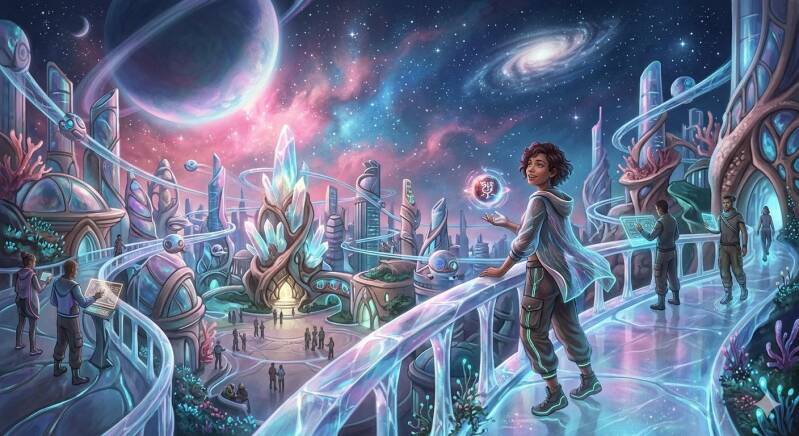
MAGICAL REALISM OF THE FUTURE
By Ilija Šaula
A Cosmic Reset and the New Coordinates of the Soul in the Age of Algorithms
Literature has suffered from nostalgia for far too long.
We have grown accustomed to viewing magical realism through the dusty windows of remote villages, through the scent of coffee, folklore, rituals, omens, and inherited memories. Yet if literature is to survive in a world increasingly saturated by algorithms rather than magic, it must stop looking exclusively backward. Its responsibility is no longer merely to preserve the past, but also to develop a language for realities that are only beginning to emerge.
The future of magical realism will not depend on its loyalty to tradition, but on its ability to become a portal into the consciousness of a generation that is still coming of age.
Today's young readers grow up within a paradox. On one side stands the cold and calculated narrative of technology; on the other, dreams, intuition, and moments of profound inward immersion continue to suggest that reality may be larger than reason alone can explain.
They receive signals that contemporary culture often dismisses as fantasy, yet these experiences frequently feel like traces of a deeper order. When such readers encounter a work that dances along the border between the possible and the impossible, something remarkable occurs: recognition.
They are not reading about distant worlds.
They are discovering an expansion of their own.
Literature becomes confirmation that what they sense behind closed eyes possesses meaning, structure, and an internal logic.
Magical realism is a way of presenting the invisible as ordinary, and the ordinary as a gateway to a deeper order of existence.
To understand this process, we may need to reconsider one of the oldest metaphors of Western civilization—the metaphor of height.
For centuries, spirituality has been imagined as a vertical ascent toward a summit, accompanied by the fear of falling. Such imagery has produced hierarchies, divisions, and a persistent anxiety before the abyss. But perhaps the soul recognizes neither summit nor bottom.
Perhaps its geometry unfolds through depth, distance, and expansion.
If so, the human being is not a creature that climbs or falls, but one that journeys.
Within such a map of consciousness, death ceases to be a final destination and becomes a point of transit.
Why does memory rarely extend beyond a few generations? Perhaps not because history has been forgotten, but because those who once lived it have long since moved beyond the framework in which that history unfolded. At the moment of a new embodiment, old memory yields to new experience. It is as if the cutting of the umbilical cord concludes one long journey and opens another chapter.
What we call death may not be an ending at all, but a departure from one frame of existence so that consciousness may inhabit another.
Magical realism is a language in which inner experience intertwines with the world, allowing the marvelous to become simply another form of reality.
This is where what might be called Cosmic Magical Realism begins.
It is a form of storytelling that transforms long stretches of history into living cycles of consciousness. Ancestors are no longer merely names preserved in family trees; they become presences that continue to participate in the unfolding movement of existence. Time itself ceases to function as the ultimate measure of being.
Limbo is no longer a place of punishment or waiting. It becomes a transitional chamber, a cosmic waiting room where souls change garments before embarking on new journeys and entering new worlds.
Perhaps we already sense traces of such an order through those strange synchronicities that sometimes resemble memories of lives we never lived.
There are people we meet for the first time and yet immediately recognize on some deeper level, as though a conversation interrupted long ago has suddenly resumed. There are others who leave inexplicable impressions upon us, marks that linger beyond reason and circumstance.
Perhaps these experiences are nothing more than psychological mechanisms.
Or perhaps they are the signatures of souls recognizing one another, leaving markers that may guide future encounters across different chapters of existence.
Magical realism is a poetics in which the supernatural appears as a natural part of reality, without explanation and without disrupting the logic of the world.
If institutional spirituality no longer provides space for such visions, literature may.
Magical realism, expanded into cosmic dimensions and interstellar relationships, may become one of the most important narrative forms of the future. Not because it offers an escape from reality, but because it helps human beings experience reality as something larger than what can be measured.
In an age marked by anxiety, acceleration, and loneliness, such literature may offer comfort, meaning, and hope.
When writers succeed in shaping these new maps of spiritual experience, they will not be offering younger generations an illusion. They will be offering a new perspective.
A perspective in which no person is entirely accidental. No encounter is entirely meaningless. And human existence is not a sequence of endings, but a continuous movement through ever-widening circles of being. In that sense, magical realism may no longer be merely a literary genre. It may become the language through which the algorithmic generation seeks to preserve what is oldest and most human within itself:
The capacity to believe that beyond the visible world, another story still waits to be told.