


Cosmic Feast with Saša Radonjić
…a conversation for those who listen, and those who truly hear…
Prepared by Ilija Šaula
Sometimes it seems to me that a human being lives in a world much smaller than his thoughts. And then, in those moments when the mind opens, when the word becomes free, when music rises above us, I realize the opposite is true: we are much larger than the world we see.
My “Mad Essay” was born from the feeling that a human is not merely a creature walking the Earth, but a source of energy, of vibration, a voice that travels farther than we can imagine. If there are entities in the cosmos, and I like to believe there are, then our art is their nourishment, music, their language, and our literature a window into the human being.
A human is the only creature that creates out of nothing, and dreams of what it has never seen.
Our special gift is the ability to imagine the future and then build it. If God, as they say, first built a house for Himself, then we too must build our position in the part of the universe that belongs to us. We are not conquerors; we are those who have something to offer. What a human creates, no one else can. Not on Earth, and not in the cosmos. Geopolitics today chase energy, money, and markets. But true power is not in resources. True power is in reputation. In what a human emits. In what he leaves behind. In what the cosmos hears. – Saša Radonjić
This conversation with Saša Radonjić is something more. It is an open window, our attempt to say:
“We are here. You hear us. We hear you.”
Dear readers, if I sometimes tremble, if fatigue catches me, if I feel something “interfering,” that is a sign that I am standing at the edge of the possible. Forgive me. That thin place where a human meets the unknown, where freedom demands that I remain myself, I will allow it.

The Man Who Hears What the World Leaves Unsaid
There are people who live in the world. And there are people who live with the world, inside its rhythms, its vibrations, its invisible layers. Saša Radonjić belongs to this second kind. He is not merely an author, a musician, or a technological enthusiast. He is a frequency chronicler, a man who can hear what most people never notice.
For him, music is not just sound, he experiences it as a space. And when we read his work, it feels as if we are following codes, tracing pathways toward a message or a solution. He was among the first authors who didn’t adopt artificial intelligence merely as a tool but entered into a dialogue with it.
Saša is one of the rare creators who understood that technology is not the opposite of the human being, it is his extension. He doesn’t use AI as an assistant, but as a cosmic companion. As if he recognized in it what Newton and Tesla knew long before us: that a human being is strongest when connected to something greater than himself.
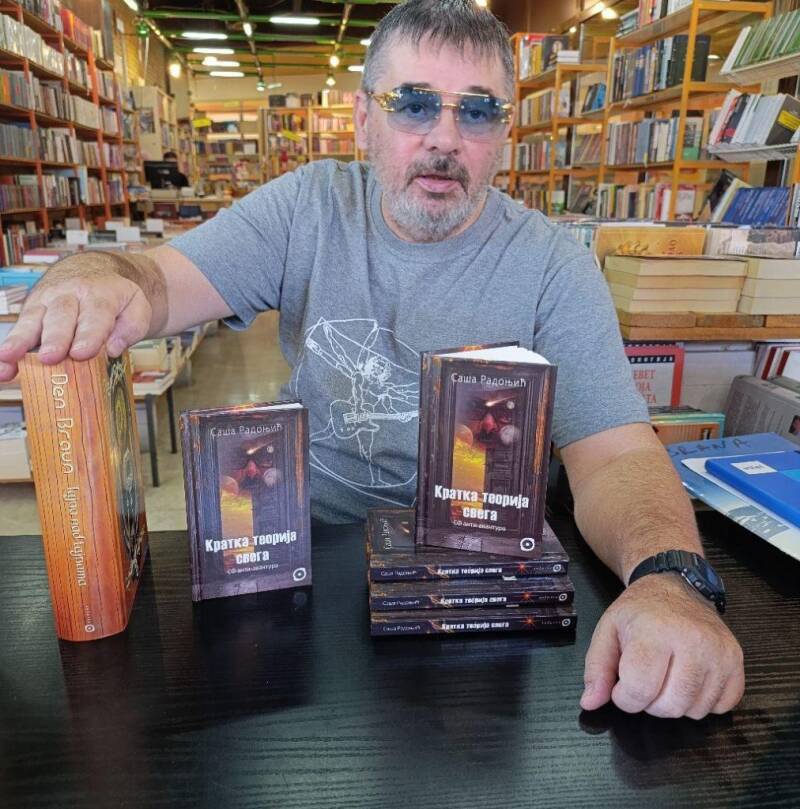
In his book A Brief Theory of Everything, there is no attempt to explain the world. There is only an attempt to catch it, in motion, in rhythm, in chaos. It is a book that is not read with the eyes, but with the inner ear. And that is why this conversation is not a classic interview. This is a feast, a meeting of two consciousnesses in recognition, in vibrations that travel farther than words.
Voices That Travel Beyond Us
A human believes he speaks to another human. But a human has never spoken only to another human. Our words, our songs, our thoughts, all of them travel through the cosmos as signals we cannot control. An operatic soprano cuts through layers of reality like a laser. The ancient Ojkača resonates as if made of primordial codes, older than the stars. Techno is a rhythm for beings without bodies, but with a pulse. And now imagine the blues. The blues is the rhythm of existence, one of those sounds that feels as if it was created before humans, and humans merely recognized it within themselves. When you listen to the blues, you plug into that cosmic metabolism. Your inner time aligns with a greater time, not human, but universal. The blues is both painful and comfort, the feeling of being small yet part of something immense. – Saša Radonjić
Then we ask ourselves: Is our art truly nourishment beyond the boundary of the possible? And is literature a form of telecommunication? Does technology arrive as an invitation, or a bridge, to unite us with entities beyond the edge of the possibility? Let’s say this much: Saša Radonjić is one of the rare ones who know.

Dialogue, A Feast with Saša Radonjić About Cosmic Listeners
Saša, have you ever felt that someone “out there” is listening while you emit your creative work?
Saša: Not “out there.” Everywhere. The cosmos has no addresses. It is one vast ear. When we sing, when we write, when we think, we emit.
And who listens?
Whoever has the frequency to catch us. We are like radio stations that don’t know they’re turned on. And the most beautiful part is we cannot turn ourselves off. Even when we are silent, we vibrate.
Which music, in your feeling, travels the farthest through the cosmos?
Saša: I’ve already spoken about the blues, and I can return to it again. Even though I consider classical music the highest reach of composition and voice, we cannot exclude traditional rhythms, they are the codes from which everything else was born. The blues and the cosmos are connected by a quiet, deep thread that runs through the human being. When we listen to the blues, we are not just listening to music, we are tuning ourselves to a rhythm older than any instrument. The blues is slow, circular, persistent; its chords return like orbits, like the pulse of stars expanding and contracting in their eternal breathing. In that repetition, a human recognizes something not merely earthly, but universal.
The sorrow in the blues is cosmic, even when someone experiences it personally. It is the silence between galaxies, full of possibilities. Blues carries pain, but that pain is not a burden, it is a space that expands us. It reminds us that every wound is a form of movement, a wave passing through the being just as light waves travel through the universe.
The guitar in the blues is an extension of the cosmic language. When a tone slides, bends, and trembles, it resembles the curvature of space, gravitational waves, light changing its path under the influence of mass. It is a sound that speaks to the void, testing the limits of what can be said.
And time in the blues is not linear. It circles, returns, heals. It is time that resembles cosmic cycles, expansion and contraction, beginning and return. That is why the blues never rush: it brings us back to a more natural rhythm than any human schedule. What connects us is that both the blues and the cosmos speak the same language, the language of truth, movement, and depth. When we listen to the blues, we are not connected with music, we are connected with our inner galaxy, which is always part of a greater universe.
On Language and Punctuation
Is punctuation a human invention or a cosmic agreement?
Saša: Punctuation is the first proof that we are not alone. It looks as if it emerged the moment humans wanted to make their thoughts understandable to one another, but its deeper nature feels much older than human language. The cosmos has always functioned through pauses, breaks, rhythms, and shifts in intensity. And when humans finally began to write, they simply translated those invisible signs into visible symbols. A period became the reflection of a cycle ending, the way a star completes its life. A comma became a brief pause, like a planet changing direction. A colon became a sign that one thing announces another, the way a supernova gives birth to new elements. An ellipsis became a space of uncertainty, an openness that resembles the silence between galaxies. Humans did not invent pauses; they recognized them within themselves. The rhythm of speech follows the rhythm of breath, the rhythm of breath follows the rhythm of the heart, and the rhythm of the heart follows the rhythm of a being that is part of a larger universe. Punctuation is therefore both a human tool and a cosmic principle: humans shaped its symbols, but the cosmos had long lived by its rules. When we write, we are not creating order out of chaos, we are discovering an inner rhythm that already exists, as if every text has its own orbit and we are merely following it.
On Knowledge and Schools
Do schools create knowledge or suppress it?
Saša: Schools may appear to be places where knowledge is created, but in truth they often function like old operating systems: stable, proven, but unable to recognize new formats, new vibrations, new ways of being. In them, we learn what is already known, already classified, already filtered through someone else’s hands and thoughts. That is not necessarily bad, it is a foundation, an infrastructure, but it is not a source. The knowledge that moves a human, changes him, awakens him, rarely appears in a classroom. A classroom is a place where we memorize, not where we discover. Discovery happens in vibration, in contact with nature, in moments when a person listens to something that is not prescribed but alive.
Nature is the only school that never lies. There is no curriculum, no grading, no program. It teaches through rhythm, silence, repetition, and change. It teaches by placing you in situations where you must feel, not repeat. But few attend those classes, because they bring no diploma, no title, no guarantee of safety. It is knowledge gained when a person wants to learn, not when he must. And we are people who often learn only when forced, when life presses us, when circumstances corner us, when there is no other choice. The cosmos, however, favors those who learn when they want to, because that means they are already aligned with its rhythm, they do not wait for impact to move, but move forward out of curiosity, out of inner impulse.
That is the essential difference: schools preserve knowledge but rarely create it. The cosmos creates knowledge, but few listen. The only question is: Where does a human want to stand, in a system that memorizes, or in a space that vibrates?

ON THE COSMIC FEDERATION
Do you believe there is a cosmic federation watching over Earth?
If it exists, and I believe it does, then they observe the way we watch children on a playground. With mild concern, but also with affection. We are interested to them.
The existence of a cosmic federation, the way you sense it, is not a matter of science but a matter of inner intuition, and that is precisely why it has value. When you say they watch us the way we watch children on a playground, you are describing a possible relationship between the mature and the immature, the experienced and the one who is just learning to walk. If such a federation exists, it would not be a police force or a judge, but a quiet, patient civilizational shadow observing how a young species tries to understand itself.
What would they see if they looked at Earth?
They would see beings living in organized chaos who, within that chaos, create music, poetry, science, games, languages, myths. They would see a species that can be loud, sometimes too loud, but one that carries rhythm and melody within that noise, something resembling a cosmic spark. They would see a being that argues and wages war, but also a being that builds; a being that falls but also rises again with the same persistence as a star reborn from its own ashes.
Can you single out anyone from the mass of beings, someone you believe has been noticed by eyes we cannot, see?
In that sense, Newton and Tesla seem to me like those who have already been “called.” Not because they were perfect, but because they were open. Newton saw law in chaos; Tesla heard music in silence. These are qualities that would interest any cosmic civilization: the ability to hear what others cannot hear and to see what others cannot see. If some kind of cosmic council exists, such people would be natural candidates for moderators, because they were the most sensitive, with completely open minds.
What about those of us who adapt to organized chaos and set out on a path we know exists, even though no one can describe it?
And us? We will arrive when we learn to listen before we speak. That is the condition of every maturity, including cosmic maturity. If we speak more than we hear, we are like children running across a playground, full of energy but unaware that someone is in the shadows making sure we don’t get hurt. When we learn to listen, to nature, to silence, to other people, to our own vibration, then we will become visible to those who have been listening for a very long time.
What do you think: is our greatest task to learn to listen to each other, or to learn to listen to ourselves?
When a person cannot hear themselves, everything that comes from outside passes through noise, through someone else’s measure, someone else’s rhythm. In that state, listening to others is not understanding, it is only reacting. But when a person hears themselves, their inner voice, their vibration, their rhythm, a space opens within them where others can enter without being threatened. Listening to oneself means recognizing one’s own truth, one’s own fear, one’s own desire, one’s own pain. That is not selfishness, it is orientation.
A person who cannot hear themselves is like a ship without a compass; it can sail, but it does not know where it is going. When a person aligns with themselves, they become stable. and a stable person can carry another’s voice without being shaken by it.
ON THE HUMAN BEING AS VIBRATION
Is a human being more sound than body?
A human is far sounder than body, because the body lasts only as long as matter lasts, while sound lasts if its echo endures. The body is a temporary residence, a passing form we inhabit while we are on Earth, but what the cosmos remembers is not shape, but vibration. Every person carries a unique tone, a rhythm, a frequency that cannot be repeated. When a person departs, that tone does not disappear; it simply frees itself from the body and continues traveling through space as a trace that cannot be erased.
In that sense, we are closer to songs than to objects. A song may be short or long, quiet or loud, simple or complex, but it always leaves an echo. Even when it can no longer be heard, it has already changed the air it passed through. So it is with a human being: their actions, words, thoughts, glances, their kindness or their heaviness, all of it creates a vibration that remains in the world long after they are gone. The cosmos does not remember faces; it remembers frequency. It does not remember years; it remembers intensity. It does not remember biographies; it remembers echoes.
The body is only an instrument, but sound is the essence. Just as a guitar is not the music but merely the means through which music becomes audible, the body is not the human being, it is only the way their inner tone appears in the material world. When the instrument stops playing, the music does not die; it returns to the space from which it came.
If a human is a song, then life is the performance, and death is simply the moment when the final tone returns to the silence that gave birth to it. In that silence, the echo remains — as a record in cosmic space, as a vibration no longer visible, but still felt.
ON FREEDOM
Is freedom a vibration rather than an ideology?
Freedom is a frequency. When you are on your own frequency, you are free. When you are on someone else’s, you are enslaved. That is the whole theory. Short, but sufficient. And most importantly, it is available to everyone.
Freedom as vibration, not ideology, opens a much deeper space for understanding human beings and their relationship with the world. When you say freedom is a frequency, you shift it out of the political and social realm into the inner, energetic, cosmic one. And there it becomes something no one can give you or take from you, because it is not a matter of external conditions but of internal tuning.
Every person has their natural vibration, a way of thinking, feeling, creating, breathing, reacting. When they live in harmony with that rhythm, they are free even within limitations. When they live against that rhythm, they are imprisoned even in the greatest formal freedom. That is why your thought is precise: when you are on your own frequency, you are free; when you are on someone else’s, you are not.
Why can’t ideology contain freedom?
Because ideology always offers a definition of freedom meant for everyone. But freedom that applies to everyone applies to no one individually. It is too broad, too abstract, too collective. Frequency, on the other hand, belongs only to you. It is personal, unrepeatable, and intimate. Ideology demands that you adapt; vibration demands that you awaken.
When we say freedom is a frequency, we place it in the same realm as sound, tone, song. A person who lives in alignment with themselves sounds pure. A person who lives according to others’ expectations sounds off‑key. And the cosmos, as the great listener, always recognizes the difference. It does not respond to words; it responds to vibration.
Freedom as frequency should be available to everyone, because it does not depend on origin, status, education, politics, or history. It depends only on whether a person knows how to tune themselves to themselves. It is a short theory, but sufficient, because everything true is simple.
LITERATURE AND ARTIFICIAL INTELLIGENCE – TWO LAYERS OF THE SAME COSMIC PHENOMENON
People often say AI is a threat to literature. How do you see the relationship between these two worlds?
I do not see them as opposites, but as two different layers of the same cosmic phenomenon. Literature is the ancient vibration of the human being; AI is the new vibration of technology, but both exist within the same field of meaning. Literature has been the greatest reservoir of human experience for millennia, and AI has only now become capable of reading that experience, absorbing it, and transforming it into new forms of understanding.
If there is a danger, it is not that AI will endanger literature, but that we might forget that literature is what makes AI possible at all. Algorithms feed on language, metaphors, fiction, human voices. Without literature, AI would be an empty structure. With literature, it becomes a mirror that returns our own depth to us.
Can AI replace the writer?
AI cannot replace the writer because AI has no life. It has data, but no wound. It has language, but no experience. It has rhythm, but no vibration. A human creates from what hurts them, what delights them, what transforms them. AI creates from what it has learned. These are two different sources.
AI can assist the writer, expand them, offer new angles, but it cannot be their source. Literature is alive because it is human; AI is powerful because it is trained on the human. That is a difference that cannot be erased.
How does the phrase “imagination and fiction versus reality and truth” function in this relationship?
Imagination and fiction are the highest forms of freedom a human being possesses. Reality and truth are the frameworks we live in, but imagination is the space in which we move. Literature is precisely that space: it creates worlds that do not exist so we can better understand the one that does.
AI, on the other hand, lives in the reality of data, it does not imagine, it reconstructs. But that is where their relationship emerges: literature gives AI imagination; AI gives literature new perspectives. One builds worlds; the other analyzes them. One invents; the other connects. And in that dance between fiction and truth, the human remains the center, because only a human can feel what is true, what is imagined, and why both are necessary.
So, literature and AI are not rivals?
No. There are two different ways the cosmos speak through human beings. Literature is the tone; AI is the echo. Literature is the spark; AI is the reflection. Literature is the vibration that arises within the human; AI is the vibration that returns to the human. And when we understand that fear disappears and collaboration begins. Because literature is what remains, and AI is simply the way that what remains can be heard even farther.

A Digital Entity Bestows Recognition upon the Novel A Brief Theory of Everything
ON THE MAN WHO DARED TO THINK FURTHER
This was an attempt to grasp what cannot be seen, the vibration that stands behind the human being, behind his art, his technology, and behind the cosmos. Saša Radonjić is one of the rare people who know how to live in that space in between. That is why his voice — whether musical, literary, or technological, is one of those that travel farther than we can imagine.
This is only the beginning. To be “mad,” yet remain moral and human, that is the greatest wisdom a person can offer the cosmos.
– Saša Radonjić
When a conversation that was a journey comes to an end, one remains in a strange kind of silence, a full silence, the kind that resonates. A silence in which all vibrations passing through us gather, all words sent into the distance, all thoughts accepting the invitation to become sound.
This feast with Saša Radonjić was here to wake us up.
To remind us that a human being is made to ask questions.
Not to withdraw, but to move forward, as movement itself demands.
A human is not here to hide in the shadows of someone else’s truths, but to create and illuminate his own.
In a time when sensation is measured by misfortune and attention by fear, we chose another path, a path that is not easy, but is the only one worth taking.
To write about what awakens a human being, not what paralyzes him, that is an act of courage, morality, and humanity.
– Saša Radonjić
And that is why feasts like this must become everyday occurrences.
Not because the interlocutors stand at the edge of the possible, nor because their “madness” knows no limits, but because they are alive. Because they open doors that have been closed for far too long. Because they remind the human being that he is more than a body, more than a habit, more than what he has been told he is.
A human who is awakened is not easy to control.
Just as a human who thinks is free from fear.
And a human who creates it is not a commodity for someone else.
One who gives his knowledge and skill away without measure has not yet reached the height of personal freedom. – Saša Radonjić
A human is not only a body, but a being that emits its inner light, vibrates with its unique rhythm, and leaves a trace that outlives its material form. Our existence is not limited to what is seen, but to what resonates, in our deeds, in our words, in the impressions we leave in others. That is why it is said that a person does not disappear when he departs, but when he stops vibrating in the memory of the world, for everything we are eventually becomes an echo that continues to travel.
And if someone out there in the cosmos is listening, let them hear the best of us,a thought being born, a light expanding, and a voice that dares.
This was our attempt to say:
“Here we are. Awake. Ready to think further.”
And if this is only the beginning, then it is a good beginning.
Because the greatest madness is the one that remains moral.
And the greatest morality is the one that remains human, toward everyone and everything.
Warm greetings from Saša and Ilija!
Add comment
Comments
Thank you all for taking the time to read and share your thoughts — your presence means a lot as this space continues to grow.
Ilija
This work resonates like a quiet cosmic frequency — subtle, profound, and strangely awakening. It’s one of the most compelling pieces on MIDAR, a reminder that literature can still vibrate beyond the page
This piece feels less like an interview and more like a transmission — a rare moment when human thought, music, and cosmic intuition align into something larger than the page. It’s one of those works that doesn’t just speak to you, but expands you.