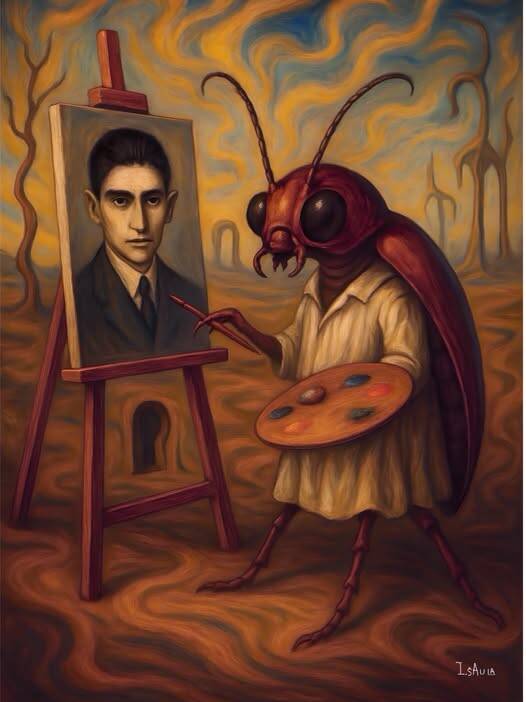
Franz Kafka
By Ilija Saula
Franz Kafka occupies a place in European literature that cannot be reduced to biography, historical context, or literary movement. His name has become a metaphor—almost a self-contained category of thought, a word that evokes a condition, an atmosphere, an inner landscape of an era. Few writers have turned their surname into an adjective, and even fewer are read as prophecy: a mirror held up to what is still arriving. Kafka is one of them. His prose is not only literature; it is a way of seeing reality from the inside.
At a moment when European culture was breaking apart between modernist exhilaration and historical catastrophe, Kafka wrote quietly, almost unobtrusively, in the shadow of his own life, with no ambition to become the voice of an age. Yet it is precisely that quiet, that withdrawal and inward focus, that made his work one of the twentieth century’s most recognizable testimonies about the human condition. Kafka did not describe reality from the outside; he dismantled it from within—as if every wall, every corridor, every institution, every word were a reflection of the mind’s inner structure.
The Individual Before the System
Kafka’s characters are not heroes in the classical sense, nor rebels and tragic protagonists who confront the world as a clearly named adversary. They are, rather, figures in motion—beings passing through a space that exceeds them, through a structure that is at once external and internal. Kafka was among the first to show that modern life often collides not with “fate” but with systems and procedures, with impersonal rules and the indifference they produce. That is why his prose can feel like an anticipation of the world we inhabit: power is rarely visible, yet persistently felt; authority is not explained, but assumed; and the individual, finally, is lost in a web of norms that no one fully understands, yet everyone is expected to obey.
Spaces of Power: Court, Castle, Family
Kafka builds recognizable “spaces of power”: castles, offices, courts, corridors, and doors are not mere scenery but settings in which abstract forces become tangible. When I read The Trial, what stayed with me most was how the court functions less as an institution than as an atmosphere in which guilt is assumed before it is proven. In The Castle, authority most often appears as absence and postponement—as a constant promise of access that is never fulfilled. In my view, The Metamorphosis makes it easiest to see how the family stops being a refuge and becomes the place where social expectations most quickly harden into moral judgment. What these worlds share is not spectacular repression, but a stable structure that defines what counts as “normal” and, by doing so, narrows the space of personal freedom.
Authority and the Deferral of Meaning
Kafka’s relationship to authority remains complex and deeply personal, yet in his fiction it expands into a universal model. Authority in Kafka often hides behind language, rules, and custom; it is strongest precisely when it is difficult to name and therefore difficult to contest. His characters are consequently oriented toward some “center”: they seek an answer that does not arrive, an explanation that is deferred, a justice that never takes a recognizable form. This pursuit is not merely a sign of weakness; it is a way of preserving a basic humanity in a world that systematically slips beyond understanding. In that sense, Kafka writes about the loss of bearings—about the moment when explanations stop holding, while life continues by inertia.
Style: Precision and Dreamlike Displacement
Kafka’s prose can feel at once rationally exact and quietly dreamlike. Its cold, almost administrative clarity frequently meets situations that escape the logic of everyday experience, so that the absurd is not an ornament but the consequence of an order carried out with ruthless consistency. As a reader, you register this as a mild unease: the sentence is clear, and yet the ground beneath its meaning seems to shift. The lines are simple on the surface, but they carry weight in what they omit and postpone. In Kafka, metaphor is rarely decorative; it is the world’s operating mechanism: Gregor’s transformation is not merely a “message” but an existential condition; the castle is a real space of perpetual delay; doors are concrete thresholds between a person and a meaning that keeps receding.
Kafka and the Twentieth Century: Diagnosis Without a Pamphlet
Kafka holds a distinctive place in cultural memory because his fiction was recognized early on as anticipating themes that would define the twentieth century: the bureaucratization of life, dehumanization, the fragmentation of identity, and the growth of impersonal mechanisms of control. And yet to reduce him to a “writer of totalitarianism” would be a narrowing. He is, above all, an analyst of inner states—of a subject under pressure in a world that has lost its stability. His works are not political tracts, but a precise anatomy of fear, guilt, and powerlessness. Kafka remains current not because history repeats itself mechanically, but because his situations touch durable patterns of human vulnerability. We recognize ourselves in that mirror not because we live under identical circumstances, but because we carry similar tensions within us.
Thresholds, Doors, and Inner Fear
Kafka can be read as a writer of boundaries: the points where dream and waking life touch, freedom and fear, meaning and meaninglessness, the individual and authority. His characters stand before doors that do not open, before thresholds they cannot cross, before institutions whose language they cannot decipher. These motifs are not merely obstacles; they show how meaning in the modern world is continually deferred and made conditional. Kafka also registers a shift in unease: it is not directed only at external pressure, but at an inner sense of powerlessness, at doubt about one’s own worth, and at the emptiness that appears when no reason can be found.
A Quieter Dimension: Empathy
Kafka’s work contains a quieter, often overlooked dimension: empathy. Behind the bureaucratic chill and formal language—which in his worlds frequently stands in for genuine human contact—one senses a careful attention to the person under strain. Kafka rarely moralizes about his characters; he follows them rather than condemns them, insisting that guilt and frailty do not exhaust themselves in individual “fault” but arise in contact with rules the character neither understands nor can control. His protagonists therefore function not only as “victims” of the plot, but as witnesses to an order in which the human being is easily reduced to a case file, a document, an error. Precisely in this absence of pathos—in the stubborn refusal to look away from the person—Kafka’s particular tenderness becomes visible.
The fact that Kafka’s world is “too large” for the individual does not cancel the need to search for meaning; on the contrary, his prose is driven by the tension between the search and the perpetual deferral of an answer. His characters move within structures that exceed them, yet they do not relinquish the basic desire to understand, to explain, to reach the “center.” In this paradox lies the source of Kafka’s lasting force: the text is dark in the situations it depicts, but it is not, in the end, simply nihilistic. It offers no comfort in ready-made resolutions; instead it leaves the reader with the sense that even the most closed systems contain a minimal space of inner resistance—in the form of a question that does not go out, an attention that refuses to give up, or a sentence that insists on naming experience nonetheless.
Precisely because of that persistence of questioning—and because Kafka’s prose sustains tension without final resolution—he exceeds the frame of a mere “theme” and becomes a literary point of orientation.
In European literature, Kafka stands as a figure at a historical hinge: firmly rooted in modernism, yet opening questions that would become central to later writing. In his work, rational order meets an experience that slips beyond it, so that the tension between procedure and inner life is not resolved but deepened. For that reason, his work can be read as both analysis and parable: precise in its language, inexhaustible in its implications. Kafka resists easy classification not because he is exceptional for exceptionalism’s sake, but because he built a world with its own logic. His name, accordingly, often functions as a label for an experience, not merely a literary reference.
Conclusion: Why We Return to Him
In the end, one does not write about Kafka in order to “close” an interpretation, but to open a space in which the world can be understood. His prose can become an instrument of self-observation: a mirror in which something appears that is difficult to say without slipping into pathos. It asks the reader to slow down, to attend to silence, to gaps, to what happens between the lines. In such attentive reading it becomes clear that meaning may be hidden without being lost; that the human being is fragile but not worthless; that the world is cold, yet not entirely sealed against the “cracks” through which light can enter.
Kafka is one of the rare writers whose work is read insistently at the borders of disciplines: literature, philosophy, psychology, and even theology and cultural studies. This does not mean, however, that everything in him is equally translatable into concepts; it is often more fruitful to remain with the tension the text produces than to reduce it to a single explanation. Kafka offers no answers; he establishes questions as form—questions of guilt, authority, and meaning. It is this openness that keeps him alive in the reader’s experience.
In an age of acceleration, when identity is often experienced as a bundle of roles and fragments, Kafka reminds us that existential questions are not solved by changing the scenery. His texts draw attention back to inner registers: fear, shame, guilt, but also a stubborn need to keep searching for meaning. When I returned to him after a long time, I noticed that the same motifs “work” differently depending on the reader’s experience: the text remains the same, but the angle from which we read it changes. Part of Kafka’s endurance lies there—not in a single message, but in the steady pressure of questions that do not stop.
Kafka is often read as an author who “casts light on darkness,” but it may be more accurate to say that he shows the mechanisms by which darkness is produced: by fear, by conditions imposed without explanation, by the way authority becomes an inner habit. His texts do not call for courage in a simple sense; they call for a sober look: what, precisely, paralyzes us; how guilt is manufactured; and how a person comes to accept rules whose source he cannot see. In this analysis Kafka does not idealize the individual; he follows him in his weakness, but also in his persistence—in spite of everything—to keep looking for something to hold on to.
Kafka’s work remains inexhaustible: we reread it because each return ends with a different emphasis, a different “key” for the same motifs. His sentences, symbols, and characters function as a system of signs that does not demand a final solution but sustained interpretation. Kafka belongs, of course, to his era, yet he surpasses it insofar as he touches general experience: guilt without a clear reason, waiting that becomes a way of life, and the need to seek meaning even when its source is invisible. That is why his name so often feels like the label of a condition, not merely the name of a writer.
Kafka is singular—and timeless; for that reason, he remains contemporary in every age.